Rose Hotel
Also known as: McFarlan's Tavern

Why it's listed
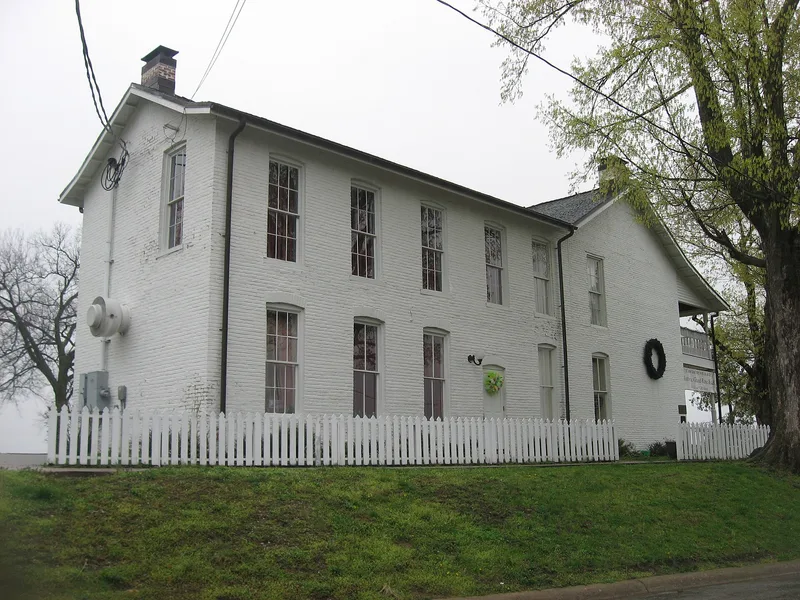
Perched on a limestone bluff above the Ohio River in Elizabethtown, Illinois, the Rose Hotel began as McFarlan's Tavern, a two-story, two-room building of grey brick said to have been built in 1812 by James McFarlan, an early settler and the town's founder. That original structure, with walls a foot thick, now serves as the hotel lobby and office. Additions followed: four rooms in 1848, a dining room in 1865, a two-story porch and stairway in 1866, and a display room for traveling salesmen in 1881. A pavilion on the bluff was built in 1882. The design echoes Colonial and Georgian houses of the East, combined with French-influenced porch forms. For decades the hotel served riverboat passengers and wagon travelers carrying salt. The 1913 flood led to a lawsuit over bluff ownership whose ruling has been cited in later cases. It was considered the oldest hotel in continuous operation in one building in Illinois until it closed.
Significance in brief: The nomination calls it one of the oldest structures in Illinois and, until it closed about two years before the nomination, the oldest hotel in continuous operation in the same building in the state. It served riverboat and overland travelers, and its architecture blends Eastern Colonial and Georgian influences with French-style features in lower Illinois. A court decision over bluff ownership after the 1913 Ohio River flood has also been widely cited.
Machine-generated summary. This summary was generated by a language model from the official nomination document and has not been reviewed line by line by an editor. It may contain errors. Check the source document before relying on any detail. Source: nomination document (PDF) · National Archives catalog entry. NRHP reference 72000461, listed December 26, 1972. Summary generated October 2026 (model claude-sonnet-5-5, prompt v1.0-2026-10-29, confidence medium).
Key facts
| Address | S. Main St., Elizabethtown |
|---|---|
| County | Hardin County |
| Listed | December 26, 1972 |
| Reference number | 72000461 |
| Resource type | Building |
| Period of significance | 19th Century (specific date given as ca. 1812-1820) |
| Architect / builder | James McFarlan (said to have built the original house in 1812) |
| Architectural style | Simplified combination of Eastern types recalling early Colonial and Georgian, with French Mississippi Valley features in the 1866 porch |
| Areas of significance | Commerce |
| Level of significance | State |
| Status (as stated in the nomination) | Condition marked good and altered; the form lists a hotel use, but the text says the hotel closed about two years earlier, and reviewers noted the conflict. |
| Acreage | 0.9 |
| Coordinates | 37.44520, -88.30437 (NPS GIS) |
What listing means for this property
For an income-producing building, listing (individually or as a contributing building in a district) is the gateway to the 20% federal rehabilitation tax credit on qualified rehabilitation costs, often stackable with state credits. Work claiming the credit must follow the Secretary of the Interior's Standards and be approved in advance.
Listing does not restrict a private owner acting without federal money or permits; where federal funding or licensing is involved, Section 106 review applies.
General information, not legal or tax advice. Rules change; confirm with your State Historic Preservation Office or a qualified adviser.
Sources and further reading
- National Park Service, National Register of Historic Places database (snapshot May 2026), reference 72000461.
- Nomination form (PDF, National Archives) — catalog entry
- Wikipedia article (used for cross-checking only; text not reproduced here)
- Wikidata Q7367800
- This listing as JSON
Last updated October 2026. Found an error? See the editorial policy for how to report it.