Carthage Jail

Why it's listed
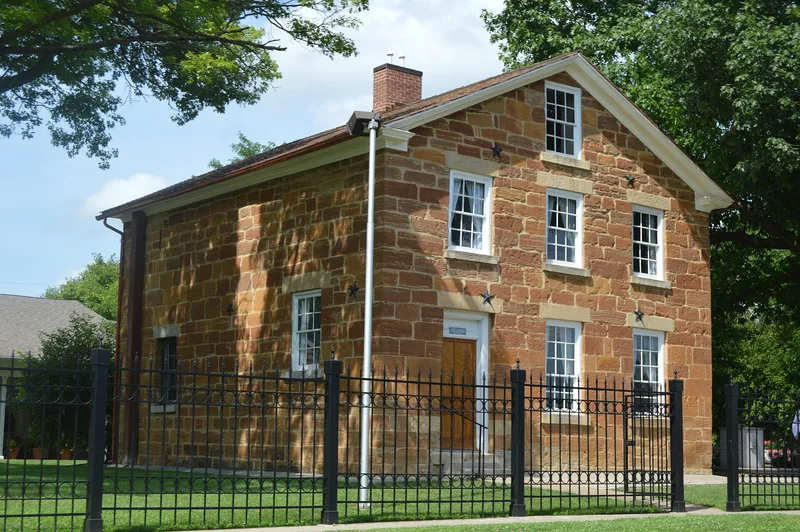
Carthage Jail is a two-story red limestone building, about 27 by 38 feet, constructed in 1839-40 at the corner of Walnut and North Fayette Streets in Carthage, Illinois. The stone was quarried roughly four miles to the northeast. It has oak rafters and floors, walnut doors, a small attic and seven rooms, including a jailer's living quarters, a debtor's room and two barred cells upstairs. On June 27, 1844, Joseph Smith, first President of the Church of Jesus Christ of Latter-day Saints, and his brother Hyrum were killed by a mob in the jailer's bedroom while awaiting a court appearance. The governor had asked that they be held in the jail for protection. The church bought the property in 1903, making it the first historic site it acquired. The building is also tied to the story of the Mormons in Illinois, who held notable political and economic influence before being driven from the state.
Significance in brief: Joseph Smith, first President of the Church of Jesus Christ of Latter-day Saints, and his brother Hyrum were assassinated here on June 27, 1844. A re-statement of significance adds that the Mormons were a major social, political and economic force in early Illinois, and that the jail is tied to their decline and exodus from the state and to the already-recognized Nauvoo district.
Machine-generated summary. This summary was generated by a language model from the official nomination document and has not been reviewed line by line by an editor. It may contain errors. Check the source document before relying on any detail. Source: nomination document (PDF) · National Archives catalog entry. NRHP reference 73000703, listed March 20, 1973. Summary generated October 2026 (model claude-sonnet-5-5, prompt v1.0-2026-10-29, confidence medium).
Key facts
| Address | Walnut and N. Fayette Sts., Carthage |
|---|---|
| County | Hancock County |
| Listed | March 20, 1973 |
| Reference number | 73000703 |
| Resource type | Building |
| Period of significance | 19th Century (built in 1839) |
| Areas of significance | Religion |
| Level of significance | National, State |
| Status (as stated in the nomination) | Described as in good condition and restored, with its present appearance much as originally built apart from normal restoration and maintenance; used as a museum. |
| Acreage | 0.8 |
| Coordinates | 40.41560, -91.13209 (NPS GIS) |
What listing means for this property
For a publicly owned building or structure, listing mainly matters when federal funds, permits or licences are involved: projects then go through Section 106 review so effects on the property are considered. Listing also strengthens applications for preservation grants and, for leased income-producing uses, can enable the federal rehabilitation tax credit.
General information, not legal or tax advice. Rules change; confirm with your State Historic Preservation Office or a qualified adviser.
Sources and further reading
- National Park Service, National Register of Historic Places database (snapshot May 2026), reference 73000703.
- Nomination form (PDF, National Archives) — catalog entry
- Wikipedia article (used for cross-checking only; text not reproduced here)
- Wikidata Q5047304
- This listing as JSON
Last updated October 2026. Found an error? See the editorial policy for how to report it.