Sesser Opera House

Why it's listed
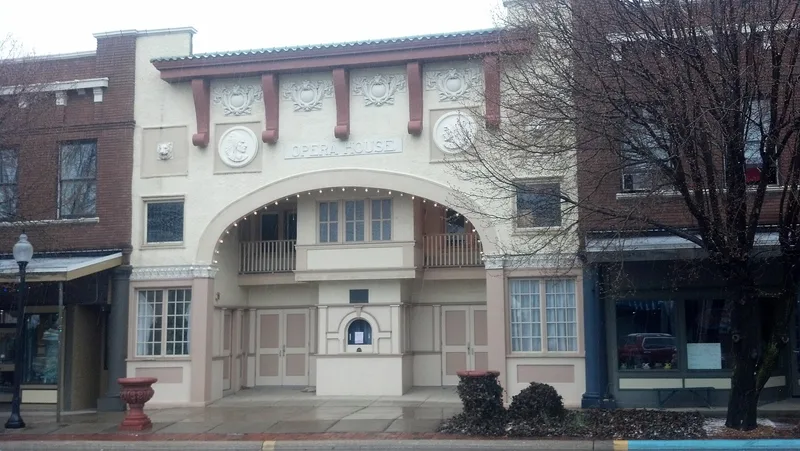
Sesser Opera House, at 106 W. Franklin Street, was built in 1914 by contractor James H. Hill with Sam Criswell and Canada Jones after an earlier frame opera house burned. The brick building is about 40 feet wide and 150 feet deep, with a tall rear stage house, an arched arcade entry, and a roughly 250 to 300 seat auditorium. Its street front combines stucco, red Spanish roof tiles, and terra cotta bands in a Mission Style rare for southern Illinois, with Egyptian Revival, Romanesque, and Sullivanesque touches and Indian-motif and wolf gargoyle details. It was planned for both films and live shows, with a projection room above the entry. The nomination calls it the only theater in Franklin County without major structural change. It hosted minstrel shows, vaudeville, school plays, talent shows, bond drives, and visiting country music performers. Alterations include 1930s seating and projector replacement and a new forced-air heating system.
Significance in brief: The nomination argues it is the only remaining theater building in Franklin County without major structural changes. It was one of six theaters operated by Reid, Yemm, and Hayes in the early 1900s. It is also described as an early small-town opera house with a projection booth built into its original plans, and it served as the community's cultural center.
Machine-generated summary. This summary was generated by a language model from the official nomination document and has not been reviewed line by line by an editor. It may contain errors. Check the source document before relying on any detail. Source: nomination document (PDF) · National Archives catalog entry. NRHP reference 82002535, listed March 12, 1982. Summary generated October 2026 (model claude-sonnet-5-5, prompt v1.0-2026-10-29, confidence medium).
Key facts
| Address | 106 W. Franklin St., Sesser |
|---|---|
| County | Franklin County |
| Listed | March 12, 1982 |
| Reference number | 82002535 |
| Resource type | Building |
| Period of significance | 1900-1914 (specific date 1914) |
| Architect / builder | James Hill (James H. Hill, contractor, with Sam Criswell and Canada Jones; Criswell brothers did the stucco and terra cotta trim) |
| Architectural style | Mission Style with elements of Egyptian Revival, Victorian Romanesque, and Sullivanesque, plus American Vernacular sculptural details |
| Areas of significance | Entertainment/Recreation |
| Level of significance | Local |
| Status (as stated in the nomination) | Condition listed as fair; the form marks the property as unoccupied, with the 1930s projectors still in place and able to be made operational. |
| Acreage | 0.9 |
| Coordinates | 38.09194, -89.05072 (NPS GIS) |
What listing means for this property
National Register listing is honorary for a privately owned home: it does not by itself restrict what an owner may do with their own money, and it does not require public access. Restrictions come from local landmark or historic-district ordinances, which are separate (how they differ).
Owner-occupied houses are not eligible for the 20% federal rehabilitation tax credit, which applies to income-producing buildings, but many states offer credits for homeowners. Listing also opens the door to preservation easements and to buying a plaque. Start with what listing means for homeowners, renovating a listed house and selling one.
Noted as vacant in the nomination. Nomination documents can be decades old; current status may differ. If you are considering buying an empty listed property, read the due-diligence checklist.
General information, not legal or tax advice. Rules change; confirm with your State Historic Preservation Office or a qualified adviser.
Sources and further reading
- National Park Service, National Register of Historic Places database (snapshot May 2026), reference 82002535.
- Nomination form (PDF, National Archives) — catalog entry
- Wikipedia article (used for cross-checking only; text not reproduced here)
- Wikidata Q7456115
- This listing as JSON
Last updated October 2026. Found an error? See the editorial policy for how to report it.