Streibich Blacksmith Shop
Also known as: Tucker Building

Why it's listed
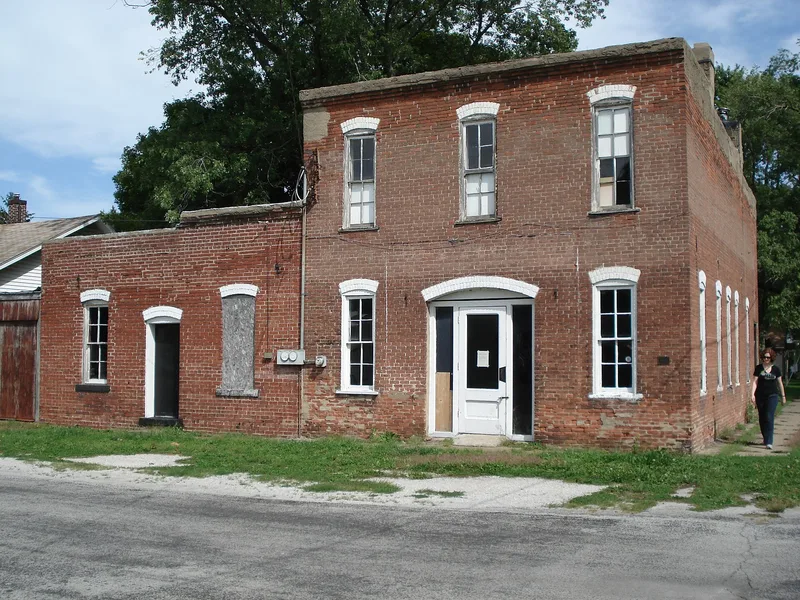
This two-story brick blacksmith shop in Newman, Illinois, stands near the northeast corner of the town square. Ignatius Streibich, a German-born smith, bought the lots in 1869 and had the plain brick building erected in the early 1870s. Its design reflects the trade: two brick forges along the south wall, a windowless north wall for judging the color of hot iron, hitching rings for shoeing horses, a dirt floor, and a line shaft that once drove shop machinery. Streibich and later his son Fred repaired wagons, plows and farm machinery, and made hardware that was not available locally. A machine shop followed from 1938 to 1969. In 1891 Streibich installed a steam-driven generator in the shop, giving Newman the first electric lighting in Douglas County. The plant lasted about a year but prepared the way for the town's later system. The original structure remains largely unaltered and the shop is still in use.
Significance in brief: The shop was essential to the commercial life of Newman and the surrounding farm area, housing a blacksmith shop and later a machine shop. In 1891 Streibich installed Douglas County's first electric power plant in the building, which laid the groundwork for the permanent town system built around 1895. The shop also keeps its original forges, tool racks and many tools.
Machine-generated summary. This summary was generated by a language model from the official nomination document and has not been reviewed line by line by an editor. It may contain errors. Check the source document before relying on any detail. Source: nomination document (PDF) · National Archives catalog entry. NRHP reference 91000086, listed February 21, 1991. Summary generated October 2026 (model claude-sonnet-5-5, prompt v1.0-2026-10-29, confidence high).
Key facts
| Address | 1 N. Howard St., Newman |
|---|---|
| County | Douglas County |
| Listed | February 21, 1991 |
| Reference number | 91000086 |
| Resource type | Building |
| Period of significance | 1870-1932 and 1938-1940 |
| Architectural style | Commercial Vernacular |
| Criteria |
|
| Areas of significance | Community Planning and Development, Commerce |
| Level of significance | Local |
| Status (as stated in the nomination) | The main part of the building is still used as a blacksmith shop, with one of the two brick forges in use. |
| Acreage | 0.9 |
| Coordinates | 39.79813, -87.97114 (NPS GIS) |
What listing means for this property
For an income-producing building, listing (individually or as a contributing building in a district) is the gateway to the 20% federal rehabilitation tax credit on qualified rehabilitation costs, often stackable with state credits. Work claiming the credit must follow the Secretary of the Interior's Standards and be approved in advance.
Listing does not restrict a private owner acting without federal money or permits; where federal funding or licensing is involved, Section 106 review applies.
General information, not legal or tax advice. Rules change; confirm with your State Historic Preservation Office or a qualified adviser.
Sources and further reading
- National Park Service, National Register of Historic Places database (snapshot May 2026), reference 91000086.
- Nomination form (PDF, National Archives) — catalog entry
- Wikipedia article (used for cross-checking only; text not reproduced here)
- Wikidata Q7623178
- This listing as JSON
Last updated October 2026. Found an error? See the editorial policy for how to report it.