Beardstown Grand Opera House

Why it's listed
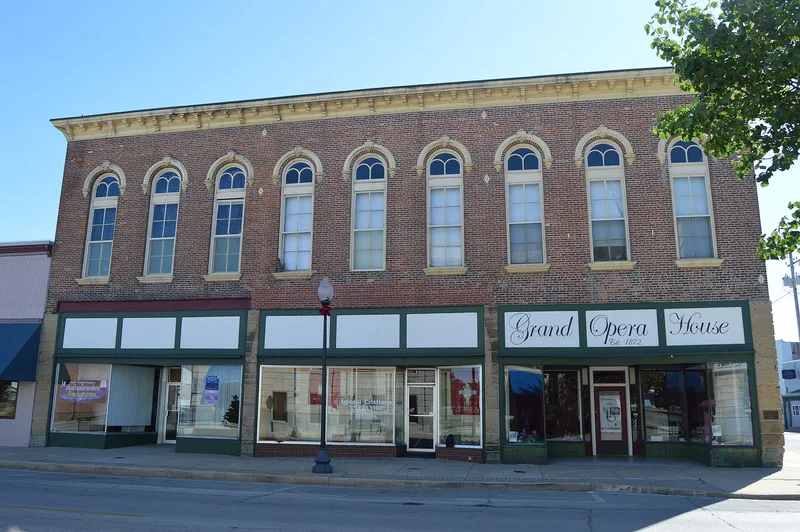
Built in 1873 at the corner of State and Second streets in Beardstown, this two-story brick building combined three ground-floor storefronts with an opera house upstairs. It replaced an earlier hotel, and its owners, George Schneider and Henry Krohe, rebuilt it after a tornado wrecked it just before completion. A major remodeling in 1893 changed the entrance to a stone arch, added electric lights, extended the building by forty feet, enlarged the stage, and installed a raked floor and a stenciled dome ceiling. A painted drop curtain showing Venice still survives. For roughly two decades the hall hosted touring theater troupes, minstrel shows, concerts and lectures. After it closed as an opera house around 1915, the upper floor served as a dance studio, then as storage. Its significance rests on its role in the small-town opera house movement. Today the city holds a long-term lease on the upper floor, and fundraising for restoration as a community center is under way.
Significance in brief: The building is argued to be locally significant under Criterion A for its association with the late 19th and early 20th century demand by small and rural communities for cultural entertainment in a specialized theatrical facility. It operated as an opera house from 1873 until about 1915 and hosted a long run of touring companies, concerts and lectures. Its 1893 remodeling added a raked floor, electric lighting, and a stenciled dome ceiling.
Machine-generated summary. This summary was generated by a language model from the official nomination document and has not been reviewed line by line by an editor. It may contain errors. Check the source document before relying on any detail. Source: nomination document (PDF) · National Archives catalog entry. NRHP reference 00000471, listed May 11, 2000. Summary generated October 2026 (model claude-sonnet-5-5, prompt v1.0-2026-10-29, confidence high).
Key facts
| Address | 121 State St., Beardstown |
|---|---|
| County | Cass County |
| Listed | May 11, 2000 |
| Reference number | 00000471 |
| Resource type | Building |
| Period of significance | 1873 - ca. 1915 |
| Architectural style | Italianate |
| Criteria |
|
| Areas of significance | Entertainment/Recreation |
| Level of significance | Local |
| Status (as stated in the nomination) | The first-floor storefronts are in use by an antique shop, a chamber of commerce and river museum, and a tumbling studio. The second-floor opera house is vacant and undergoing preservation and restoration for use as a community center. |
| Acreage | 0.99 |
| Coordinates | 40.01752, -90.43431 (NPS GIS) |
What listing means for this property
National Register listing is honorary for a privately owned home: it does not by itself restrict what an owner may do with their own money, and it does not require public access. Restrictions come from local landmark or historic-district ordinances, which are separate (how they differ).
Owner-occupied houses are not eligible for the 20% federal rehabilitation tax credit, which applies to income-producing buildings, but many states offer credits for homeowners. Listing also opens the door to preservation easements and to buying a plaque. Start with what listing means for homeowners, renovating a listed house and selling one.
General information, not legal or tax advice. Rules change; confirm with your State Historic Preservation Office or a qualified adviser.
Sources and further reading
- National Park Service, National Register of Historic Places database (snapshot May 2026), reference 00000471.
- Nomination form (PDF, National Archives) — catalog entry
- Wikipedia article (used for cross-checking only; text not reproduced here)
- Wikidata Q4876694
- This listing as JSON
Last updated October 2026. Found an error? See the editorial policy for how to report it.