Brussels Historic District

Why it's listed
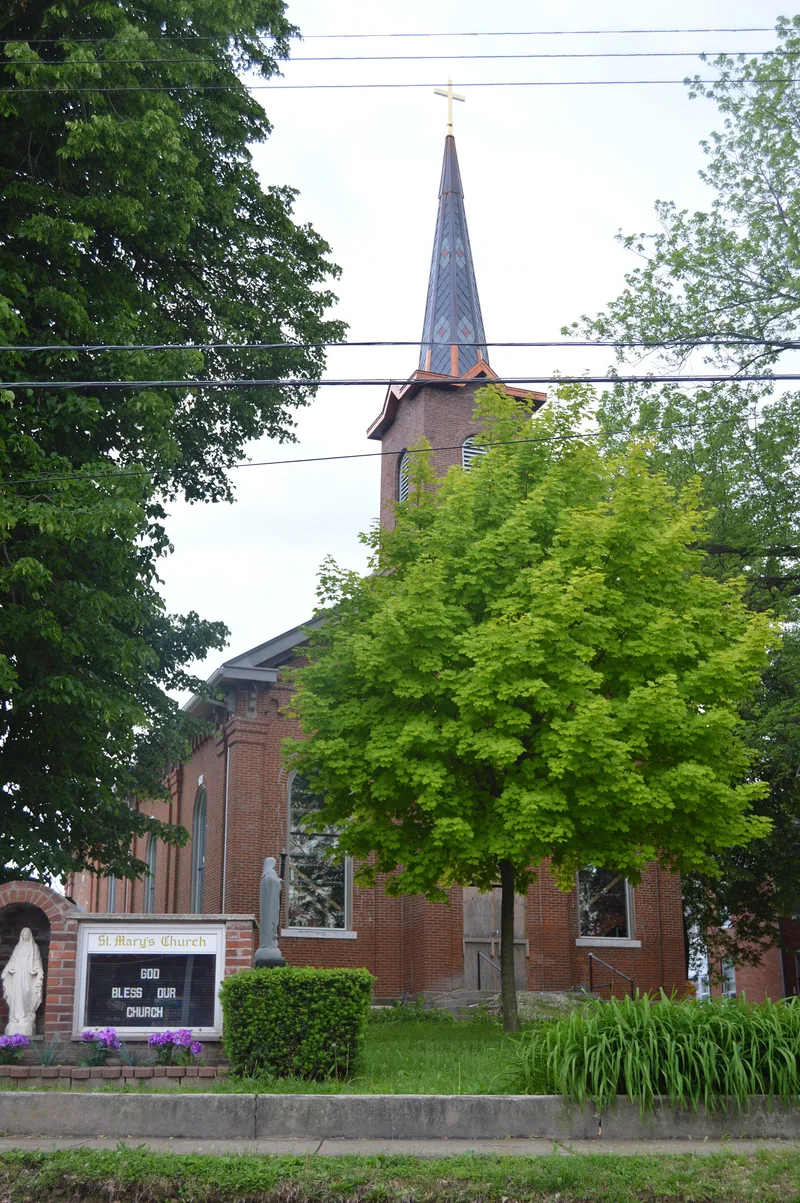
Brussels Historic District takes in most of a small village on the bluffs above the Illinois River in southern Calhoun County, Illinois. Main Street winds northwest for about seven-tenths of a mile, with a short stretch along Community Avenue. The district counts 82 contributing resources, including about 21 houses, ten commercial buildings, St. Mary's Catholic Church of 1863, a convent, a parochial school, a cemetery and many barns, sheds and privies. Most buildings are vernacular frame or brick structures with metal gable roofs, and several stores were built with a residence attached. Queen Anne, Italianate and Greek Revival styles appear in a few examples. The village grew after German families arrived in 1843, and Conrad Wittmond opened a trading post in 1847 that survives as the oldest continuously operating business. Low building density, large lots and little alteration keep the nineteenth-century village character visible.
Significance in brief: The district preserves a small, little-altered river-bluff village settled by German and Irish families from the 1840s onward. Its frame and brick buildings, many combining a store with an attached residence, reflect local building traditions and the village's commercial and Catholic parish history. The text also notes long-running businesses such as Wittmond's Trading Post, founded in 1847.
Machine-generated summary. This summary was generated by a language model from the official nomination document and has not been reviewed line by line by an editor. It may contain errors. Check the source document before relying on any detail. Source: nomination document (PDF) · National Archives catalog entry. NRHP reference 98000981, listed August 6, 1998. Summary generated October 2026 (model claude-sonnet-5-5, prompt v1.0-2026-10-29, confidence medium).
Key facts
| Address | Roughly along Main and Community Sts., Brussels |
|---|---|
| County | Calhoun County |
| Listed | August 6, 1998 |
| Reference number | 98000981 |
| Resource type | District |
| Architectural style | Late Victorian; Mid-19th Century (Queen Anne, Italianate and Greek Revival examples among mostly vernacular buildings) |
| Areas of significance | Commerce, Social History |
| Level of significance | Local |
| Status (as stated in the nomination) | Most buildings have had little physical change; updates are mainly porch changes and synthetic siding. Many buildings remain in use as homes, a restaurant and hotel, a church and a school, though one commercial building (Schleeper Building) is described as vacant. |
| Acreage | 80 |
| Coordinates | 38.95118, -90.58931 (NPS GIS) |
What listing means for this property
This is a historic district. Buildings within its boundary are either contributing (they add to the district's significance) or non-contributing. Owners of contributing income-producing buildings can claim the 20% federal rehabilitation tax credit; homeowners should look at state credits. National Register districts impose no design review by themselves; a local historic district ordinance, if one exists, does (the difference explained).
General information, not legal or tax advice. Rules change; confirm with your State Historic Preservation Office or a qualified adviser.
Sources and further reading
- National Park Service, National Register of Historic Places database (snapshot May 2026), reference 98000981.
- Nomination form (PDF, National Archives) — catalog entry
- Wikipedia article (used for cross-checking only; text not reproduced here)
- Wikidata Q17512476
- This listing as JSON
Last updated October 2026. Found an error? See the editorial policy for how to report it.