Boyd Mill Place
Also known as: Davenport's Mill; Hearon's Mill

Why it's listed
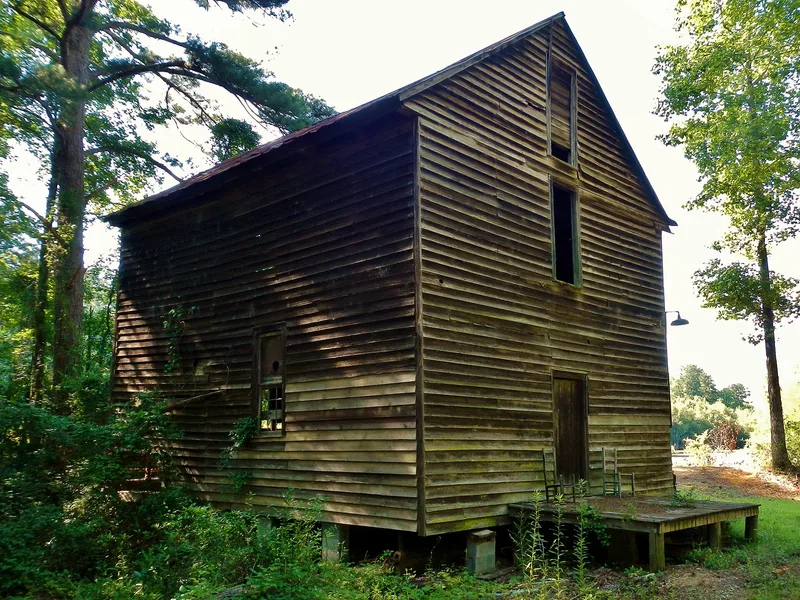
Boyd Mill Place is a 60-acre rural property in Webster County, Georgia, centered on a two-story wood-frame gristmill built around 1870 beside a millpond formed by a 400-foot earthen dam. The mill, built by John Boyd, ground corn into meal, grits and flour for area farmers until 1963. Heavy timber framing, a turbine beneath the building, millstones, sifting hoppers and a canvas elevator survive, so the mill could operate again with minimal repairs. Nearby are a one-story New South cottage built around 1910 for the miller and a barn, shed and chicken house from the 1930s, when owner William Davenport also added a generator and a sawmill. The property is the last surviving gristmill in the county and among the few in Georgia with its machinery intact. It was recognized for its architecture, engineering, agriculture, industry and commerce, and the pond long served community gatherings such as baptisms and fish fries.
Significance in brief: The mill is the last surviving gristmill in Webster County and one of few in Georgia that retain their processing machinery. It is significant for architecture, engineering, agriculture, industry and commerce, showing how corn was milled with water power for area farmers from c. 1870 to 1963.
Machine-generated summary. This summary was generated by a language model from the official nomination document and has not been reviewed line by line by an editor. It may contain errors. Check the source document before relying on any detail. Source: nomination document (PDF) · National Archives catalog entry. NRHP reference 09000752, listed September 24, 2009. Summary generated October 2026 (model claude-sonnet-5-5, prompt v1.0-2026-10-29, confidence high).
Key facts
| Address | 580 Mill Pond Rd., Weston |
|---|---|
| County | Webster County |
| Listed | September 24, 2009 |
| Reference number | 09000752 |
| Resource type | District |
| Period of significance | c.1870-1963 |
| Architectural style | Other: New South cottage; Other: grist mill |
| Criteria |
|
| Areas of significance | Architecture, Agriculture, Engineering, Commerce, Industry |
| Level of significance | State |
| Status (as stated in the nomination) | Current function listed as vacant/not in use alongside single dwelling. The mill retains nearly all its grinding equipment, though the mill and chicken house are in deteriorated condition. |
| Acreage | 60 |
| Coordinates | 31.97414, -84.54435 (NPS GIS) |
What listing means for this property
This is a historic district. Buildings within its boundary are either contributing (they add to the district's significance) or non-contributing. Owners of contributing income-producing buildings can claim the 20% federal rehabilitation tax credit; homeowners should look at state credits. National Register districts impose no design review by themselves; a local historic district ordinance, if one exists, does (the difference explained).
General information, not legal or tax advice. Rules change; confirm with your State Historic Preservation Office or a qualified adviser.
Sources and further reading
- National Park Service, National Register of Historic Places database (snapshot May 2026), reference 09000752.
- Nomination form (PDF, National Archives) — catalog entry
- Wikipedia article (used for cross-checking only; text not reproduced here)
- Wikidata Q28124289
- This listing as JSON
Last updated October 2026. Found an error? See the editorial policy for how to report it.