Ross, John, House

Why it's listed
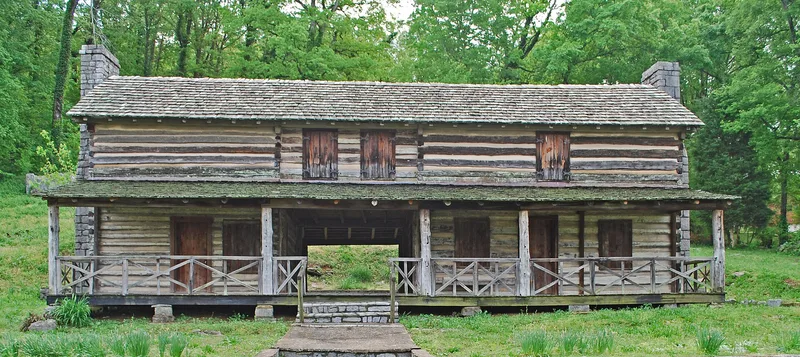
This two-story square-timbered log house in Rossville, Georgia, is tied to John Ross, the Cherokee leader who served as principal chief from 1828 until removal in 1839. Ross moved here after Georgia's confiscatory acts of 1830 forced him out of his fine home on the Coosa River near Rome. The log house has lime plaster chinking later replaced with cement, a shaked roof, two outside stone chimneys, and porches front and back. A breezeway divides two rooms on the first floor, and three rooms sit above. It has been moved a few hundred yards from its original spot among stores and luncheonettes to a wooded, parklike setting. Ross, a hero of Horseshoe Bend in the Creek War, championed Cherokee self-government and the 1827 constitution. He led delegations protesting expulsion and guided his people west on the Trail of Tears. He later led the united Cherokee Nation in the West until 1862. The house is significant for its link to these political events of 1830 to 1838.
Significance in brief: The house was the home of John Ross, the most prominent Cherokee chief, who led the Cherokee Nation as principal chief from 1828 until removal in 1839 and opposed the removal treaties. Ross moved here after Georgia's confiscatory acts of 1830 and led protests against the expulsion. He also led his people west on the Trail of Tears and served as a Creek War hero and statesman.
Machine-generated summary. This summary was generated by a language model from the official nomination document and has not been reviewed line by line by an editor. It may contain errors. Check the source document before relying on any detail. Source: nomination document (PDF) · National Archives catalog entry. NRHP reference 73000647, listed November 7, 1973. Summary generated October 2026 (model claude-sonnet-5-5, prompt v1.0-2026-10-29, confidence medium).
Key facts
| Address | Lake Ave. and Spring St., Rossville |
|---|---|
| County | Walker County |
| Listed | November 7, 1973 |
| Reference number | 73000647 |
| Resource type | Building |
| Period of significance | 1830-1838 |
| Areas of significance | Native American, Politics/Government, Social History |
| Level of significance | National |
| National Historic Landmark | Yes, designated November 7, 1973 |
| Status (as stated in the nomination) | Condition listed as excellent, very slightly altered, and moved from its original site; a 1973 Interior listing describes it as a private residence not open to the public. |
| Acreage | 3 |
| Within district | Chickamauga and Chattanooga National Military Park |
| Coordinates | 34.97507, -85.28468 (NPS GIS) |
What listing means for this property
National Register listing is honorary for a privately owned home: it does not by itself restrict what an owner may do with their own money, and it does not require public access. Restrictions come from local landmark or historic-district ordinances, which are separate (how they differ).
Owner-occupied houses are not eligible for the 20% federal rehabilitation tax credit, which applies to income-producing buildings, but many states offer credits for homeowners. Listing also opens the door to preservation easements and to buying a plaque. Start with what listing means for homeowners, renovating a listed house and selling one.
General information, not legal or tax advice. Rules change; confirm with your State Historic Preservation Office or a qualified adviser.
Sources and further reading
- National Park Service, National Register of Historic Places database (snapshot May 2026), reference 73000647.
- Nomination form (PDF, National Archives) — catalog entry
- Wikipedia article (used for cross-checking only; text not reproduced here)
- Wikidata Q14686678
- This listing as JSON
Last updated October 2026. Found an error? See the editorial policy for how to report it.