Metcalfe Historic District

Why it's listed
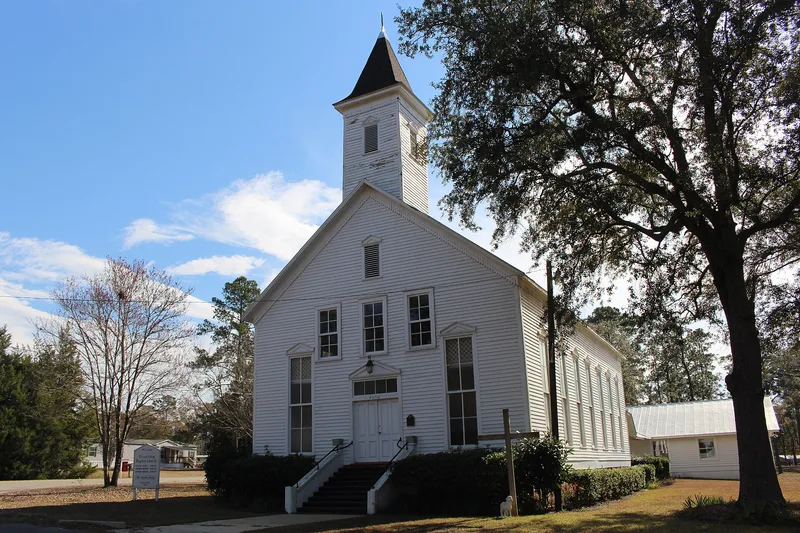
Metcalfe is a small railroad town in Thomas County, Georgia, whose core of 35 significant structures, built between 1887 and 1920, survives as a late Victorian community. The settlement grew after a railroad from Thomasville to Monticello, Florida, was announced in 1887, and the depot opened in 1888. Most buildings are of native long leaf yellow pine. Notable examples include the railroad depot, the 1889-90 Baptist Church with its saw tooth trim, the 1890 Rushin-Willett House with Queen Anne features, the Crenshaw-Thomas House with Eastlake detailing, a 1915 bungalow, brick commercial buildings and a cotton gin. The town was incorporated in 1889 and shipped cotton, watermelons, pears and timber. After about 1906, nearby Thomasville drew away residents and business, and reduced rail service led to decline by the 1920s. The district was recognized as an intact example of a railroad boom town, and its appearance remains close to that of 1888.
Significance in brief: Metcalfe is significant as a representative of towns created by the railroad in the late nineteenth century, serving as a center for commerce and agricultural trade, especially cotton. Its surviving buildings from 1887-1890 are examples of commercial and residential Victorian architecture with Queen Anne and Eastlake features.
Machine-generated summary. This summary was generated by a language model from the official nomination document and has not been reviewed line by line by an editor. It may contain errors. Check the source document before relying on any detail. Source: nomination document (PDF) · National Archives catalog entry. NRHP reference 78001007, listed September 20, 1978. Summary generated October 2026 (model claude-sonnet-5-5, prompt v1.0-2026-10-29, confidence high).
Key facts
| Address | Roughly bounded by Magnolia, Hancock, Louis and Williams Sts., Metcalf |
|---|---|
| County | Thomas County |
| Listed | September 20, 1978 |
| Reference number | 78001007 |
| Resource type | District |
| Period of significance | 1887-1920 |
| Architectural style | Late Victorian, with Queen Anne and Eastlake Style features |
| Areas of significance | Commerce, Transportation, Architecture, Agriculture |
| Level of significance | Local |
| Status (as stated in the nomination) | Residential structures are generally in excellent condition. The depot was deteriorated but under restoration, the Rushin-Willett House was being restored, and the Horne Cotton Gin was dilapidated. Twelve recent intrusions do not destroy the district's integrity. |
| Acreage | 96.4 |
| Coordinates | 30.70020, -83.98720 (NPS GIS) |
What listing means for this property
This is a historic district. Buildings within its boundary are either contributing (they add to the district's significance) or non-contributing. Owners of contributing income-producing buildings can claim the 20% federal rehabilitation tax credit; homeowners should look at state credits. National Register districts impose no design review by themselves; a local historic district ordinance, if one exists, does (the difference explained).
General information, not legal or tax advice. Rules change; confirm with your State Historic Preservation Office or a qualified adviser.
Sources and further reading
- National Park Service, National Register of Historic Places database (snapshot May 2026), reference 78001007.
- Nomination form (PDF, National Archives) — catalog entry
- Wikipedia article (used for cross-checking only; text not reproduced here)
- Wikidata Q30621791
- This listing as JSON
Last updated October 2026. Found an error? See the editorial policy for how to report it.