Richland Historic District
Also known as: See Also:Smith-Alston House

Why it's listed
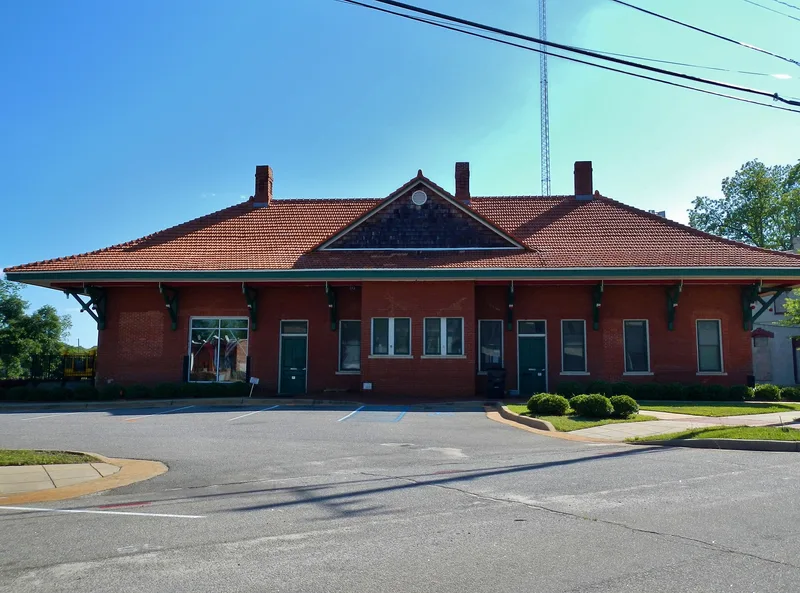
Richland is a small southwest Georgia town that began at the crossing of the Americus-Lumpkin and Columbus-Albany roads, where Henry Audulf settled in 1827. Railroads reached it in 1885 and 1890, turning it into a junction and a shipping center for cotton and other crops. The historic district preserves that growth: one- and two-story brick commercial buildings from the 1890s to 1920s, including the 1890 Richland Hotel and Bank, a ca. 1900 mule barn, the 1913 depot, the 1905 city hall and the 1907 waterworks. Surrounding streets hold mostly wood-framed houses in Victorian Eclectic, Neoclassical and Craftsman styles, plus two antebellum houses, three churches, two cemeteries and a 1934 school. Housing for upper, middle and working-class black and white residents survives. The town's historic fabric was virtually complete by 1935, after the boll weevil, the Depression and trucking slowed growth.
Significance in brief: The district is significant for community planning, transportation, architecture, commerce and social history. Richland began at a crossroads and grew rapidly after railroads arrived in the 1880s and 1890s, and its gridiron plan was adjusted to fit existing roads and rail lines. Its buildings document late 19th- and early 20th-century building types in west central Georgia.
Machine-generated summary. This summary was generated by a language model from the official nomination document and has not been reviewed line by line by an editor. It may contain errors. Check the source document before relying on any detail. Source: nomination document (PDF) · National Archives catalog entry. NRHP reference 86001021, listed May 5, 1986. Summary generated October 2026 (model claude-sonnet-5-5, prompt v1.0-2026-10-29, confidence high).
Key facts
| Address | Roughly bounded by Ponder, Harmony, Broad and Olemen, and Wali Sts., Richland |
|---|---|
| County | Stewart County |
| Listed | May 5, 1986 |
| Reference number | 86001021 |
| Resource type | District |
| Period of significance | 1830s - 1936 |
| Architect / builder | Multiple; Thomas W. Smith of Columbus, Georgia, designed the Methodist Church |
| Architectural style | Greek Revival, Victorian Eclectic, Neoclassical, Craftsman/Bungalow, late Victorian commercial |
| Criteria |
|
| Areas of significance | Commerce, Transportation, Architecture, Social History |
| Level of significance | Local |
| Status (as stated in the nomination) | Described as occupied; a one-room brick calaboose is in dilapidated condition. The form lists the district's condition as deteriorated and altered. |
| Acreage | 200 |
| Coordinates | 32.09395, -84.66006 (NPS GIS) |
What listing means for this property
This is a historic district. Buildings within its boundary are either contributing (they add to the district's significance) or non-contributing. Owners of contributing income-producing buildings can claim the 20% federal rehabilitation tax credit; homeowners should look at state credits. National Register districts impose no design review by themselves; a local historic district ordinance, if one exists, does (the difference explained).
General information, not legal or tax advice. Rules change; confirm with your State Historic Preservation Office or a qualified adviser.
Sources and further reading
- National Park Service, National Register of Historic Places database (snapshot May 2026), reference 86001021.
- Nomination form (PDF, National Archives) — catalog entry
- Wikipedia article (used for cross-checking only; text not reproduced here)
- Wikidata Q7330638
- This listing as JSON
Last updated October 2026. Found an error? See the editorial policy for how to report it.