Bedingfield Inn
Also known as: See Also:Lumpkin Commercial Historic District
Bedingfield Inn is a building in Lumpkin, Stewart County, Georgia, listed on the National Register of Historic Places on May 7, 1973 (reference number 73000643). The National Park Service records its significance in Commerce, Transportation and Architecture at the state level.
Facts from the NPS National Register database (); nomination summary October 2026. Last updated . Sources for each fact.

Approximate location: the National Park Service places this pin arbitrarily within the property, not at a surveyed point (stated accuracy ±12 m).
Why it's listed
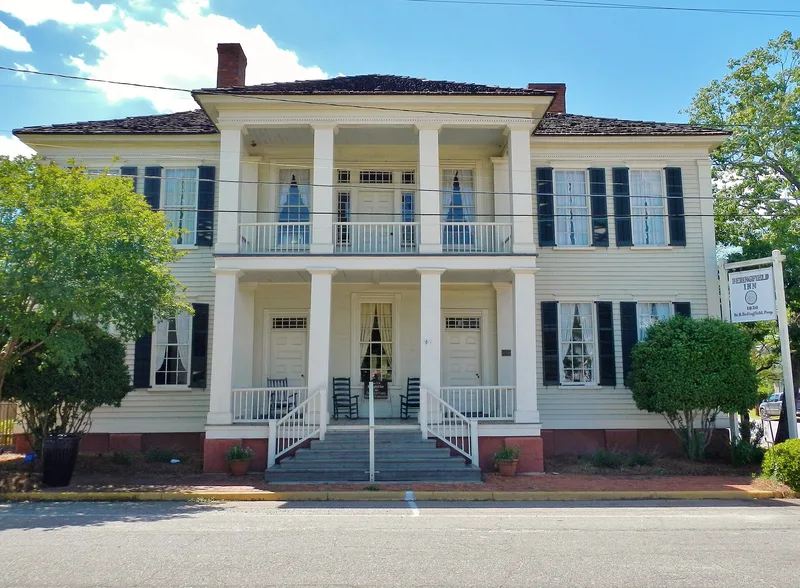
Bedingfield Inn is a two-story, weatherboarded building with a hip roof, seven bays and a double portico with square columns, standing on Cotton Street across from the town square in Lumpkin, Georgia. Dr. Bryan N. Bedingfield, a prosperous physician who also worked as a surveyor and storekeeper, built it around 1836 as both his family home and a stagecoach inn. Its location made it a convenient stopping place for travelers between Americus, Georgia, and Eufaula, Alabama, and a hub of local commercial and community life. The design is described as a simplified rural version of Classical Revival style, similar to other hip-roofed frame houses with central double porches in Georgia. Over the years the building served as a photographer's studio, millinery shop, boarding house, apartments and offices. Restored in 1965, it now hosts civic meetings and operates as a museum furnished to suggest an 1840 stagecoach inn.
Significance in brief: The nomination presents it as a good example of how Classical Revival style was adapted in rural Georgia, with a hip roof and central double square-columned porch. It was also a center of commercial and community activity for travelers between Americus, Georgia, and Eufaula, Alabama. Its varied later uses and 1965 restoration as a museum add to its interest.
Machine-generated summary. This summary was generated by a language model from the official nomination document and has not been reviewed line by line by an editor. It may contain errors. Check the source document before relying on any detail. Source: nomination document (PDF) · National Archives catalog entry. NRHP reference 73000643, listed May 7, 1973. Summary generated October 2026 (model claude-sonnet-5-5, prompt v1.0-2026-10-29, confidence high).
Key facts
| Official database NPS National Register database, ref. 73000643 , checked | |
|---|---|
| Address | Cotton St., Lumpkin |
| County | Stewart County |
| Listed | May 7, 1973 |
| Reference number | 73000643 |
| Resource type | Building |
| Areas of significance | Commerce, Transportation, Architecture |
| Level of significance | State |
| National Historic Landmark | No |
| Acreage | 0.9 |
| Official document, machine-extracted Nomination form (National Archives) , checked | |
| Period of significance | 19th Century (c.1836) |
| Architect / builder | Dr. Bryan N. Bedingfield (builder/owner) |
| Architectural style | Rural version of Classical Revival |
| Status (as stated in the nomination) | Excellent condition; restored in 1965 and used as a meeting place for civic groups and as a museum of early travel accommodations. Located on its original site. |
| Official dataset NPS cultural-resource GIS (NRHP locations) | |
| Coordinates | 32.05074, -84.79542 |
| Computed Computed from NPS GIS district boundaries | |
| Within district | Lumpkin Commercial Historic District |
What listing means for this property
For an income-producing building, listing (individually or as a contributing building in a district) is the gateway to the 20% federal rehabilitation tax credit on qualified rehabilitation costs, often stackable with state credits. Work claiming the credit must follow the Secretary of the Interior's Standards and be approved in advance.
Listing does not restrict a private owner acting without federal money or permits; where federal funding or licensing is involved, Section 106 review applies.
General information, not legal or tax advice. Rules change; confirm with your State Historic Preservation Office or a qualified adviser.
Questions about Bedingfield Inn
When was Bedingfield Inn added to the National Register of Historic Places?
Bedingfield Inn was listed on May 7, 1973. Its National Register reference number is 73000643.
Is Bedingfield Inn a National Historic Landmark?
No. The National Park Service database (snapshot of May 2026) lists Bedingfield Inn on the National Register but does not record it as a National Historic Landmark.
Where is Bedingfield Inn?
Cotton St., Lumpkin, Stewart County, Georgia; coordinates 32.05074, -84.79542.
Why is Bedingfield Inn historically significant?
According to a machine-generated summary of its nomination form: The nomination presents it as a good example of how Classical Revival style was adapted in rural Georgia, with a hip roof and central double square-columned porch. It was also a center of commercial and community activity for travelers between Americus, Georgia, and Eufaula, Alabama. Its varied later uses and 1965 restoration as a museum add to its interest. Check the nomination document before relying on any detail.
Who designed or built Bedingfield Inn?
The nomination form names Dr. Bryan N. Bedingfield (builder/owner) as architect or builder (extracted by machine from the nomination; check the source document).
Is Bedingfield Inn in a historic district?
Yes. Its location falls within the Lumpkin Commercial Historic District, itself listed on the National Register. (Computed from National Park Service boundary data; the district nomination's own list of contributing resources may differ.)
Where can I read the original nomination for Bedingfield Inn?
The nomination form is a public record held by the National Archives: nomination document (PDF).
Sources and further reading
- National Park Service, National Register of Historic Places database (snapshot May 2026), reference 73000643.
- Nomination form (PDF, National Archives) — catalog entry
- Wikidata Q87816914
- This listing as JSON
Last updated October 2026. Found an error? See the editorial policy for how to report it.