Bath Presbyterian Church and Cemetery

Why it's listed
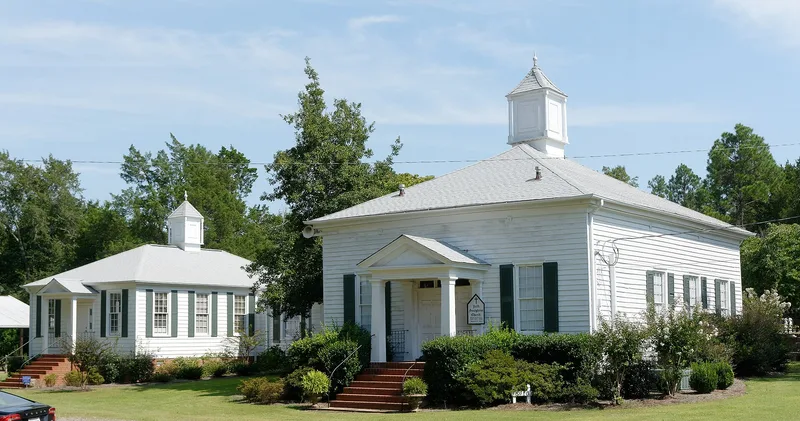
Bath Presbyterian Church and Cemetery sit half a mile west of U.S. 1 in the small village of Bath, about 15 miles southwest of Augusta. Bath developed as a summer resort where wealthy Burke County families came for spring waters and relief from summer fevers. Those families founded the congregation, which shared a pastor with Waynesboro until 1879. The present white clapboard church, almost square under a hipped roof, was completed about 1836 by Massachusetts-born carpenter John Trowbridge. It keeps its original pulpit, chandelier, plaster walls and a balcony built as a slave gallery. A Greek Revival Sunday school wing dates to about 1860, and a fellowship hall was added in 1991. Behind the church, the cemetery holds 124 identified graves, the earliest marked one dated 1814. It contains marble monuments, rustic iron fences and above-ground burials. The property is recognized for its architecture, funerary art, religious history and evidence of enslaved worshippers, and the congregation still meets there.
Significance in brief: The nomination argues the church is a well-preserved antebellum rural church and one of the oldest buildings in continuous use by a Presbyterian congregation in Georgia. The cemetery is significant for its marble markers, iron fencing and varied burial forms. The intact slave balcony documents the otherwise poorly recorded presence of enslaved people at the Bath summer resort.
Machine-generated summary. This summary was generated by a language model from the official nomination document and has not been reviewed line by line by an editor. It may contain errors. Check the source document before relying on any detail. Source: nomination document (PDF) · National Archives catalog entry. NRHP reference 04001179, listed October 27, 2004. Summary generated October 2026 (model claude-sonnet-5-5, prompt v1.0-2026-10-29, confidence high).
Key facts
| Address | Edie Bath Rd., 0.5 mi. W of US 1, Blythe |
|---|---|
| County | Richmond County |
| Listed | October 27, 2004 |
| Reference number | 04001179 |
| Resource type | Building |
| Period of significance | 1814 - 1954 |
| Architect / builder | Trowbridge, John (1817-1894), master carpenter, born in Mass., moved to Georgia in 1830s |
| Architectural style | OTHER: rural antebellum church (with Greek Revival-style portico and Sunday school wing) |
| Criteria |
|
| Areas of significance | Architecture, Art, Religion, Social History |
| Level of significance | State |
| Status (as stated in the nomination) | The church continues to be used as a church, as it has since 1836; the cemetery is also still in its historic function. |
| Acreage | 4.6 |
| Coordinates | 33.33605, -82.17266 (NPS GIS) |
What listing means for this property
Religious properties are listed for their architectural or historical significance, not their religious use. Listing is honorary and does not restrict the congregation's use of the building. The federal rehabilitation credit is generally unavailable unless part of the building is income-producing; some state programmes and preservation grants do cover religious buildings. Federal funding or permits trigger Section 106 review.
General information, not legal or tax advice. Rules change; confirm with your State Historic Preservation Office or a qualified adviser.
Sources and further reading
- National Park Service, National Register of Historic Places database (snapshot May 2026), reference 04001179.
- Nomination form (PDF, National Archives) — catalog entry
- Wikipedia article (used for cross-checking only; text not reproduced here)
- Wikidata Q14686599
- This listing as JSON
Last updated October 2026. Found an error? See the editorial policy for how to report it.