Rockville Academy and St. Paul Methodist Church Historic District

Why it's listed
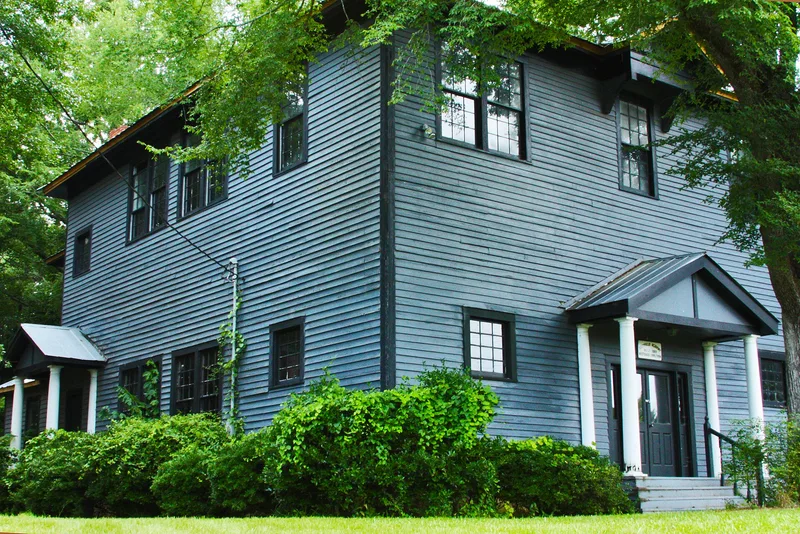
Rockville Academy and St. Paul Methodist Church form a small rural district east of Eatonton, Georgia, set among fields and woods along Rockville Road. The academy, built in late 1889 and opened in January 1890, is a two-story frame building with a stone foundation and Colonial Revival character. It replaced three neighborhood schools under Georgia's school consolidation law, and it is believed to be one of the first consolidated rural schools in the state. An auditorium was added in the early twentieth century, and the school also taught manual and vocational skills. About 100 yards away, the frame church was built around 1897 on land donated by the academy's principal. It keeps its original pews, floors, windows and a single-column recessed entry. A ball field developed by the WPA in the 1930s and a small cemetery complete the district. The school closed in 1944 as the community declined.
Significance in brief: The district is significant in architecture because the academy and church are well-preserved examples of rural community landmark buildings. Two-story wooden rural schools are rare in Georgia, and the church has unusual details such as eave brackets and a single column at its recessed entry. It is significant in education because the academy is believed to be one of the first rural consolidated schools in Georgia, and it also offered vocational training.
Machine-generated summary. This summary was generated by a language model from the official nomination document and has not been reviewed line by line by an editor. It may contain errors. Check the source document before relying on any detail. Source: nomination document (PDF) · National Archives catalog entry. NRHP reference 02001382, listed November 19, 2002. Summary generated October 2026 (model claude-sonnet-5-5, prompt v1.0-2026-10-29, confidence high).
Key facts
| Address | E of Eatonton and S of GA 16, Rockville Rd., Eatonton |
|---|---|
| County | Putnam County |
| Listed | November 19, 2002 |
| Reference number | 02001382 |
| Resource type | District |
| Period of significance | 1889-1952 |
| Architectural style | Late 19th and 20th Century Revivals: Colonial Revival and Classical Revival |
| Criteria |
|
| Areas of significance | Architecture, Education |
| Level of significance | Local |
| Status (as stated in the nomination) | The academy closed in 1944 and sat vacant until a restoration association restored it. The classroom is now a museum room, and the current functions listed are social/civic and cemetery. |
| Acreage | 3 |
| Coordinates | 33.32579, -83.21886 (NPS GIS) |
What listing means for this property
This is a historic district. Buildings within its boundary are either contributing (they add to the district's significance) or non-contributing. Owners of contributing income-producing buildings can claim the 20% federal rehabilitation tax credit; homeowners should look at state credits. National Register districts impose no design review by themselves; a local historic district ordinance, if one exists, does (the difference explained).
General information, not legal or tax advice. Rules change; confirm with your State Historic Preservation Office or a qualified adviser.
Sources and further reading
- National Park Service, National Register of Historic Places database (snapshot May 2026), reference 02001382.
- Nomination form (PDF, National Archives) — catalog entry
- Wikidata Q141805475
- This listing as JSON
Last updated October 2026. Found an error? See the editorial policy for how to report it.