Rockmart Downtown Historic District

Why it's listed
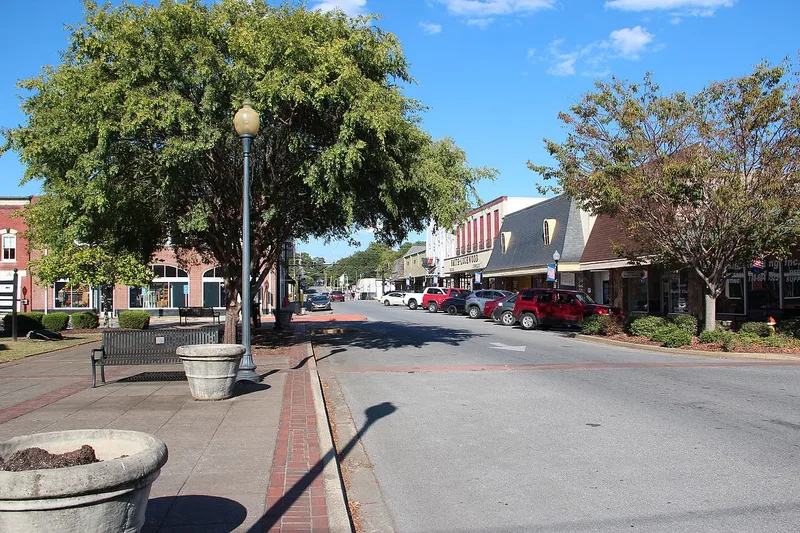
Downtown Rockmart, in Polk County in northwest Georgia, grew up along a railroad after Colonel Seaborn Jones laid out the town in 1871. The historic district centers on Marble Street and nearby side streets. It holds mostly one- and two-story brick commercial buildings with recessed storefronts, display windows and corbeled brickwork, many attached by party walls. Community landmarks include the 1882 Presbyterian church, built of local slate, the 1914 Romanesque-style Methodist church, the 1921 Colonial Revival city hall and a 1951 county office building. At the southwest end stand cotton gins and warehouses, and the 1929 water treatment plant is also included. Slate, used for walls and roofs and mined by Welsh miners, is unusual in Georgia. The district was listed for its architecture, its role as the commercial center of the area, and its early town planning. It covers 38 contributing and 11 noncontributing resources from 1871 to 1959.
Significance in brief: The district is significant in architecture for its intact collection of commercial, community landmark and industrial buildings typical of small Georgia towns from the late 19th to early 20th centuries. It also stands out for the local use of slate as a building and roofing material. It is significant in commerce as the area's commercial center, and in community planning and development for the town plan laid out in 1871.
Machine-generated summary. This summary was generated by a language model from the official nomination document and has not been reviewed line by line by an editor. It may contain errors. Check the source document before relying on any detail. Source: nomination document (PDF) · National Archives catalog entry. NRHP reference 09000458, listed June 24, 2009. Summary generated October 2026 (model claude-sonnet-5-5, prompt v1.0-2026-10-29, confidence high).
Key facts
| Address | Roughly bounded by Water, Beauregard, Narble, and Elm Sts., Rockmart |
|---|---|
| County | Polk County |
| Listed | June 24, 2009 |
| Reference number | 09000458 |
| Resource type | District |
| Period of significance | 1871-1959 |
| Architectural style | Late Victorian: Romanesque; Colonial Revival; Commercial Style |
| Criteria |
|
| Areas of significance | Architecture, Commerce, Community Planning and Development |
| Level of significance | Local |
| Status (as stated in the nomination) | Many buildings remain in commercial, government and religious use. The 1921 city hall now houses the police department, and the 1951 county building is a senior center. |
| Acreage | 26 |
| Coordinates | 33.99690, -85.05436 (NPS GIS) |
What listing means for this property
This is a historic district. Buildings within its boundary are either contributing (they add to the district's significance) or non-contributing. Owners of contributing income-producing buildings can claim the 20% federal rehabilitation tax credit; homeowners should look at state credits. National Register districts impose no design review by themselves; a local historic district ordinance, if one exists, does (the difference explained).
General information, not legal or tax advice. Rules change; confirm with your State Historic Preservation Office or a qualified adviser.
Sources and further reading
- National Park Service, National Register of Historic Places database (snapshot May 2026), reference 09000458.
- Nomination form (PDF, National Archives) — catalog entry
- Wikidata Q141805466
- This listing as JSON
Last updated October 2026. Found an error? See the editorial policy for how to report it.