Lexington Historic District

Why it's listed
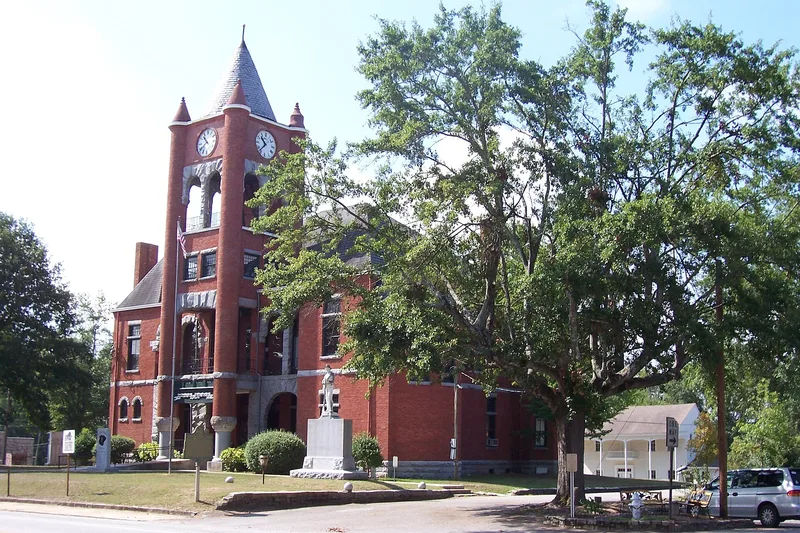
Lexington, the seat of Oglethorpe County in northeast Georgia, was founded around 1796 and became incorporated in 1806. The historic district takes in most of the town's streets and more than 200 acres. It includes plain-style frame houses, several that were later updated with Greek Revival columns and porticos, Victorian residences, two 19th-century churches, a brick jail from about 1879 and a Richardsonian Romanesque-influenced courthouse from about 1887. Commercial buildings face the courthouse along Main Street, and smaller cottages line Boggs Street and Black Bottom Road. In the early 1800s the town was a political, legal and commercial center, home at various times to figures such as William Harris Crawford, George Gilmer and the Lumpkin family. When the Georgia Railroad bypassed the town in the 1840s, growth slowed, and much of the older building stock survived. The district was listed for this concentration of preserved 19th-century architecture and its associations with prominent Georgians.
Significance in brief: Lexington was a center of political, judicial and commercial activity in early 19th-century Georgia, and many prominent Georgians lived, studied or practiced law there. After the railroad bypassed it in the 1840s the town declined, which helped preserve a large number of historic buildings. It is presented as an excellent example of a 19th-century Georgia community.
Machine-generated summary. This summary was generated by a language model from the official nomination document and has not been reviewed line by line by an editor. It may contain errors. Check the source document before relying on any detail. Source: nomination document (PDF) · National Archives catalog entry. NRHP reference 77000442, listed April 13, 1977. Summary generated October 2026 (model claude-sonnet-5-5, prompt v1.0-2026-10-29, confidence medium).
Key facts
| Address | U.S. 78, Lexington |
|---|---|
| County | Oglethorpe County |
| Listed | April 13, 1977 |
| Reference number | 77000442 |
| Resource type | District |
| Architectural style | Plantation plain style, Greek Revival, Victorian, and Richardsonian Romanesque-influenced civic architecture |
| Areas of significance | Commerce, Education, Law, Politics/Government, Architecture, Social History |
| Level of significance | State |
| Status (as stated in the nomination) | Condition is marked as ranging from excellent to deteriorated. Modern intrusions are mostly along Main Street and have a minor impact on the district. |
| Acreage | 200 |
| Coordinates | 33.87225, -83.11046 (NPS GIS) |
What listing means for this property
This is a historic district. Buildings within its boundary are either contributing (they add to the district's significance) or non-contributing. Owners of contributing income-producing buildings can claim the 20% federal rehabilitation tax credit; homeowners should look at state credits. National Register districts impose no design review by themselves; a local historic district ordinance, if one exists, does (the difference explained).
General information, not legal or tax advice. Rules change; confirm with your State Historic Preservation Office or a qualified adviser.
Sources and further reading
- National Park Service, National Register of Historic Places database (snapshot May 2026), reference 77000442.
- Nomination form (PDF, National Archives) — catalog entry
- Wikidata Q49516361
- This listing as JSON
Last updated October 2026. Found an error? See the editorial policy for how to report it.