Springer Opera House

Why it's listed
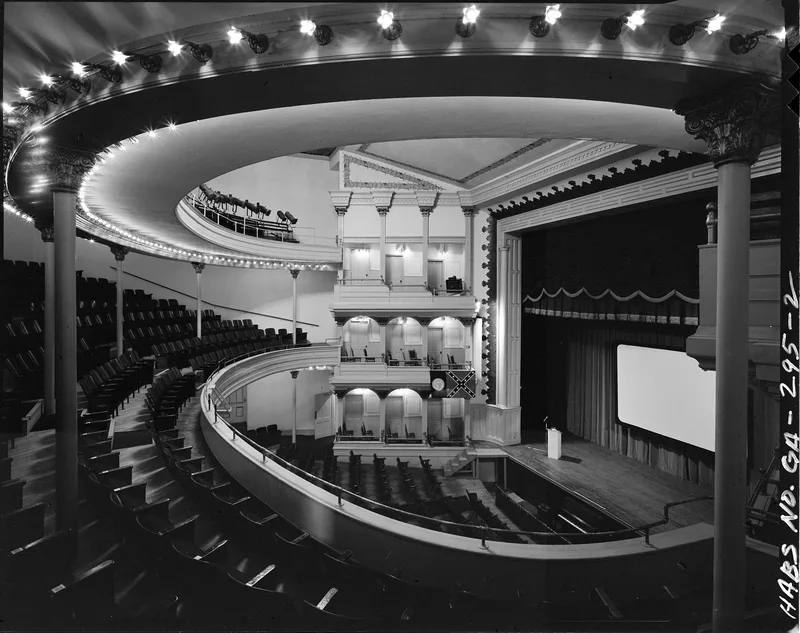
Built in 1871 for Francis Joseph Springer, an immigrant from Alsace, this opera house occupies a massive three-story red brick building at First Avenue and Tenth Street in Columbus, Georgia. Architect Daniel Mathew Foley designed it, and the building once also served as a Victorian hotel. The 450-seat auditorium has two balconies, three tiers of boxes, stenciled borders and a stage with a wooden grid, one of very few left in America. Its first event was an amateur concert, but over the decades it hosted performers such as Edwin Booth, Oscar Wilde, Will Rogers and Ethel Barrymore, along with lecturers and statesmen. Changing entertainment habits turned it into a movie house, and it closed in 1959. A citizens' group formed in 1964 and led a restoration funded locally. A theater museum off the lobby displays photographs, costumes and memorabilia. The nomination cites this record of performances and the local rescue as its reasons for recognition.
Significance in brief: The nomination argues the theater is of national if not international importance because it hosted many leading figures of late 19th and early 20th century American theater, as well as boxers, lecturers and statesmen. It also highlights the retention of original features, including a rare wooden stage grid, and a locally led restoration after the building closed in 1959.
Machine-generated summary. This summary was generated by a language model from the official nomination document and has not been reviewed line by line by an editor. It may contain errors. Check the source document before relying on any detail. Source: nomination document (PDF) · National Archives catalog entry. NRHP reference 70000214, listed December 29, 1970. Summary generated October 2026 (model claude-sonnet-5-5, prompt v1.0-2026-10-29, confidence high).
Key facts
| Address | 105 10th St., Columbus |
|---|---|
| County | Muscogee County |
| Listed | December 29, 1970 |
| Reference number | 70000214 |
| Resource type | Building |
| Period of significance | 1871 (19th century) |
| Architect / builder | Daniel Mathew Foley (architect); Francis Joseph Springer (builder) |
| Areas of significance | Communications, Performing Arts |
| Level of significance | National |
| National Historic Landmark | Yes, designated June 2, 1978 |
| Status (as stated in the nomination) | Restored opera house in use as a theater and museum; upper stories used for storage and only the opera house had been restored at the time of nomination. |
| Acreage | 0.9 |
| Coordinates | 32.46486, -84.99077 (NPS GIS) |
What listing means for this property
National Register listing is honorary for a privately owned home: it does not by itself restrict what an owner may do with their own money, and it does not require public access. Restrictions come from local landmark or historic-district ordinances, which are separate (how they differ).
Owner-occupied houses are not eligible for the 20% federal rehabilitation tax credit, which applies to income-producing buildings, but many states offer credits for homeowners. Listing also opens the door to preservation easements and to buying a plaque. Start with what listing means for homeowners, renovating a listed house and selling one.
General information, not legal or tax advice. Rules change; confirm with your State Historic Preservation Office or a qualified adviser.
Sources and further reading
- National Park Service, National Register of Historic Places database (snapshot May 2026), reference 70000214.
- Nomination form (PDF, National Archives) — catalog entry
- Wikipedia article (used for cross-checking only; text not reproduced here)
- Wikidata Q7580869
- This listing as JSON
Last updated October 2026. Found an error? See the editorial policy for how to report it.