Bowens, Eddie, Farm
Also known as: Seabrook Village Foundation

Why it's listed
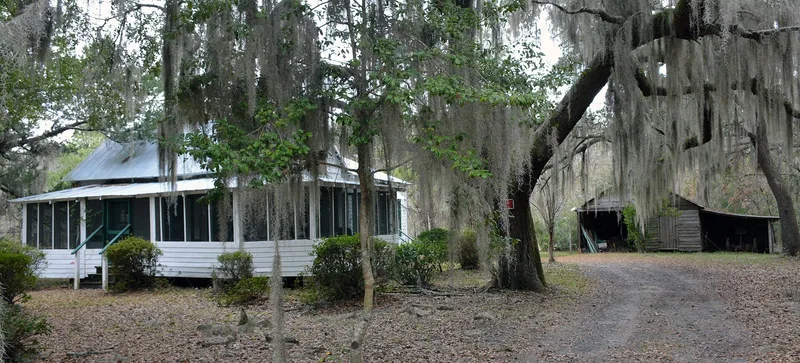
Eddie Bowens built a two-room hall-parlor house in 1903 on land in the Seabrook community of Liberty County, Georgia, and farmed the surrounding nine acres until his death in 1987. Over the following decades he added rooms, a wrap-around porch and an enclosed hallway to the weatherboard house. The farmstead also includes a well, a 1930s doghouse, a rebuilt barn and chicken coop, informal plantings of ornamental, edible and medicinal plants, and the remains of a rice dam and fields that predate 1917. Bowens worked as a farmer, carpenter, oysterman and root medicine practitioner, and served as a church deacon. The property was listed as a representative African-American farmstead of the post-Civil War era and as a good example of a hall-parlor house that evolved over time. Since 1993 it has been part of a heritage museum operated by the Seabrook Village Foundation, with the house used for offices, a gift shop and exhibits.
Significance in brief: The farm is argued to be an excellent example of an early-to-mid-20th-century African-American farm, tied to Eddie Bowens, a farmer and root practitioner. It is also a good example of a vernacular hall-parlor house that grew through historic additions. It retains a historic agricultural landscape and a rice dam and fields from the coastal rice-growing era.
Machine-generated summary. This summary was generated by a language model from the official nomination document and has not been reviewed line by line by an editor. It may contain errors. Check the source document before relying on any detail. Source: nomination document (PDF) · National Archives catalog entry. NRHP reference 04001209, listed October 25, 2004. Summary generated October 2026 (model claude-sonnet-5-5, prompt v1.0-2026-10-29, confidence high).
Key facts
| Address | 660 Trade Hill Rd., Seabrook |
|---|---|
| County | Liberty County |
| Listed | October 25, 2004 |
| Reference number | 04001209 |
| Resource type | Building |
| Period of significance | 1903-1954 |
| Architectural style | OTHER: hall-parlor |
| Criteria |
|
| Areas of significance | Agriculture, Architecture, Black |
| Level of significance | State |
| Status (as stated in the nomination) | The house has been rehabilitated and serves as the Seabrook Village Foundation's administrative office, gift shop and gallery space within its heritage museum. The grape arbor and fields are kept planted, and the rice fields are overgrown. |
| Acreage | 9 |
| Coordinates | 31.74421, -81.31920 (NPS GIS) |
What listing means for this property
National Register listing is honorary for a privately owned home: it does not by itself restrict what an owner may do with their own money, and it does not require public access. Restrictions come from local landmark or historic-district ordinances, which are separate (how they differ).
Owner-occupied houses are not eligible for the 20% federal rehabilitation tax credit, which applies to income-producing buildings, but many states offer credits for homeowners. Listing also opens the door to preservation easements and to buying a plaque. Start with what listing means for homeowners, renovating a listed house and selling one.
General information, not legal or tax advice. Rules change; confirm with your State Historic Preservation Office or a qualified adviser.
Sources and further reading
- National Park Service, National Register of Historic Places database (snapshot May 2026), reference 04001209.
- Nomination form (PDF, National Archives) — catalog entry
- Wikidata Q134383048
- This listing as JSON
Last updated October 2026. Found an error? See the editorial policy for how to report it.