Commerce Commercial Historic District
Also known as: Harmony Grove Commercial Historic District

Why it's listed
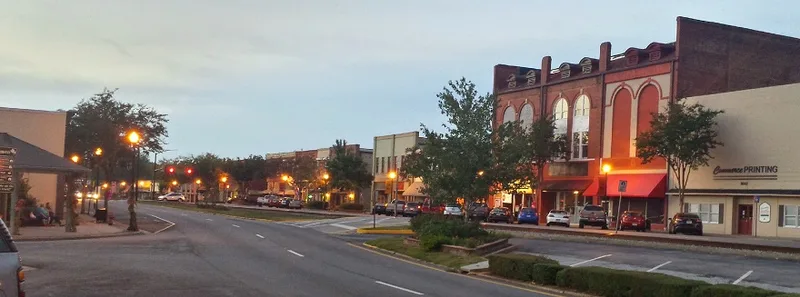
Downtown Commerce, Georgia, originally the post village of Harmony Grove, is preserved in a nine-acre district of brick buildings dating from about 1850 to 1938. Most are attached one- and two-story stores with upstairs offices, many decorated with recessed squares, triangles, corbelling and pilasters. Some storefronts are cast iron made by a local foundry, and the Babcock Building has an upper facade of decorative cast concrete block. The 1910 Opera House has large round-arched second-floor windows. A brick and frame Presbyterian church from 1912 shows Romanesque Revival features, and three brick industrial plants, including the Blue Bell complex, reflect the town's manufacturing growth. The district was listed because the town became a major regional distribution center after the railroad arrived in the 1870s, taking the name Commerce in 1906. Its irregular street plan, shaped by converging wagon roads and the rail line, also sets it apart from the typical Georgia gridiron.
Significance in brief: The district is significant in architecture for its collection of late 19th and early 20th century brick commercial and industrial buildings, including decorative brickwork, cast-iron storefronts and a cast concrete block facade. It is also significant in commerce and industry as a regional distribution center that grew with the railroad. Its irregular street plan, shaped by wagon roads and the rail line, adds significance in community planning.
Machine-generated summary. This summary was generated by a language model from the official nomination document and has not been reviewed line by line by an editor. It may contain errors. Check the source document before relying on any detail. Source: nomination document (PDF) · National Archives catalog entry. NRHP reference 88003226, listed January 19, 1989. Summary generated October 2026 (model claude-sonnet-5-5, prompt v1.0-2026-10-29, confidence medium).
Key facts
| Address | Roughly bounded by Line, State, Cherry, Sycamore and Broad Sts., Commerce |
|---|---|
| County | Jackson County |
| Listed | January 19, 1989 |
| Reference number | 88003226 |
| Resource type | District |
| Period of significance | 1850-1938 |
| Architectural style | Late Victorian/Romanesque; Late Victorian/Italianate; Late 19th and Early 20th Century American Movements/commercial style |
| Criteria |
|
| Areas of significance | Industry, Community Planning and Development, Commerce, Architecture |
| Level of significance | Local |
| Status (as stated in the nomination) | The church at the east edge of the district is described as vacant; the form does not give a general condition for the rest of the district, which has commercial and manufacturing uses. |
| Acreage | 9 |
| Coordinates | 34.20380, -83.45650 (NPS GIS) |
What listing means for this property
This is a historic district. Buildings within its boundary are either contributing (they add to the district's significance) or non-contributing. Owners of contributing income-producing buildings can claim the 20% federal rehabilitation tax credit; homeowners should look at state credits. National Register districts impose no design review by themselves; a local historic district ordinance, if one exists, does (the difference explained).
General information, not legal or tax advice. Rules change; confirm with your State Historic Preservation Office or a qualified adviser.
Sources and further reading
- National Park Service, National Register of Historic Places database (snapshot May 2026), reference 88003226.
- Nomination form (PDF, National Archives) — catalog entry
- Wikidata Q49479471
- This listing as JSON
Last updated October 2026. Found an error? See the editorial policy for how to report it.