Lula Residential Historic District

Why it's listed
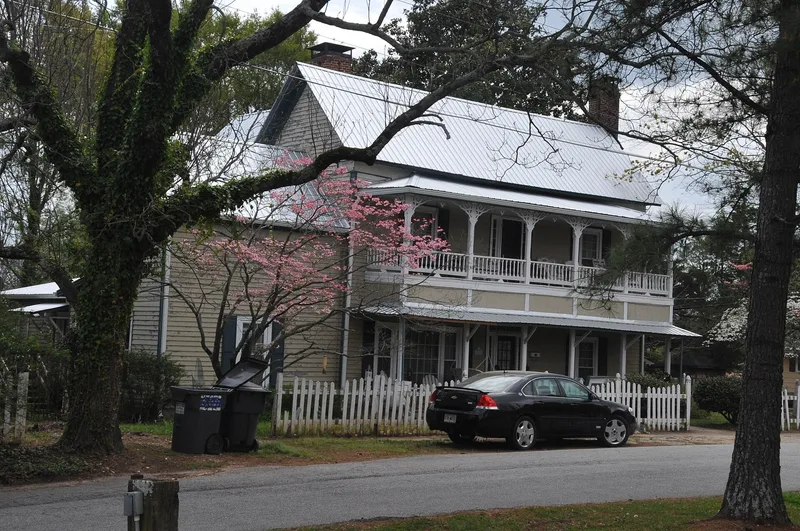
Lula's western residential neighborhood, around Cobb, Carter, Chattahoochee and Toombs Streets in northeastern Hall County, Georgia, is a compact district of about 12 acres. It contains late 19th- and early 20th-century houses and a simple wood-framed Methodist church. Most buildings are vernacular in form with Victorian-eclectic details, including chamfered or bracketed porch posts, doors with transoms and sidelights, chimneys with decorative brickwork, and metal or shingle roofs. One corner house combines Victorian styling with Craftsman details. The streets follow a grid laid out in a plan and survey by landowner Joel Hurt, who sold lots in the 1870s as the railroad arrived. Joseph H. and Dunstan E. Banks deeded land for the junction of two railroads, and a post office opened at Lula Junction in 1877. The town was renamed Lula in 1879 and chartered in 1905. The district is the only intact group of historic homes in the community and has no non-contributing properties.
Significance in brief: The district is the only intact group of historic residences in Lula, representing small-town residential architecture in north Georgia at the turn of the century. It is also tied to the town's growth after the railroad junction was established in the 1870s, and to early Lula residents such as the first postmaster, merchants and a banker.
Machine-generated summary. This summary was generated by a language model from the official nomination document and has not been reviewed line by line by an editor. It may contain errors. Check the source document before relying on any detail. Source: nomination document (PDF) · National Archives catalog entry. NRHP reference 85002244, listed September 11, 1985. Summary generated October 2026 (model claude-sonnet-5-5, prompt v1.0-2026-10-29, confidence high).
Key facts
| Address | Cobb, Carter, Chattahoochee and Toombs Sts., Lula |
|---|---|
| County | Hall County |
| Listed | September 11, 1985 |
| Reference number | 85002244 |
| Resource type | District |
| Period of significance | 1873 - 1934 |
| Architect / builder | various |
| Architectural style | Vernacular with Victorian-eclectic elements |
| Areas of significance | Community Planning and Development, Commerce, Architecture |
| Level of significance | Local |
| Status (as stated in the nomination) | Described as in good condition, with some alterations, on its original site; the properties are occupied and are private residences plus a church. All properties are listed as contributing. |
| Acreage | 12 |
| Coordinates | 34.38587, -83.66990 (NPS GIS) |
What listing means for this property
This is a historic district. Buildings within its boundary are either contributing (they add to the district's significance) or non-contributing. Owners of contributing income-producing buildings can claim the 20% federal rehabilitation tax credit; homeowners should look at state credits. National Register districts impose no design review by themselves; a local historic district ordinance, if one exists, does (the difference explained).
General information, not legal or tax advice. Rules change; confirm with your State Historic Preservation Office or a qualified adviser.
Sources and further reading
- National Park Service, National Register of Historic Places database (snapshot May 2026), reference 85002244.
- Nomination form (PDF, National Archives) — catalog entry
- Wikidata Q49520129
- This listing as JSON
Last updated October 2026. Found an error? See the editorial policy for how to report it.