Grace Church

Why it's listed
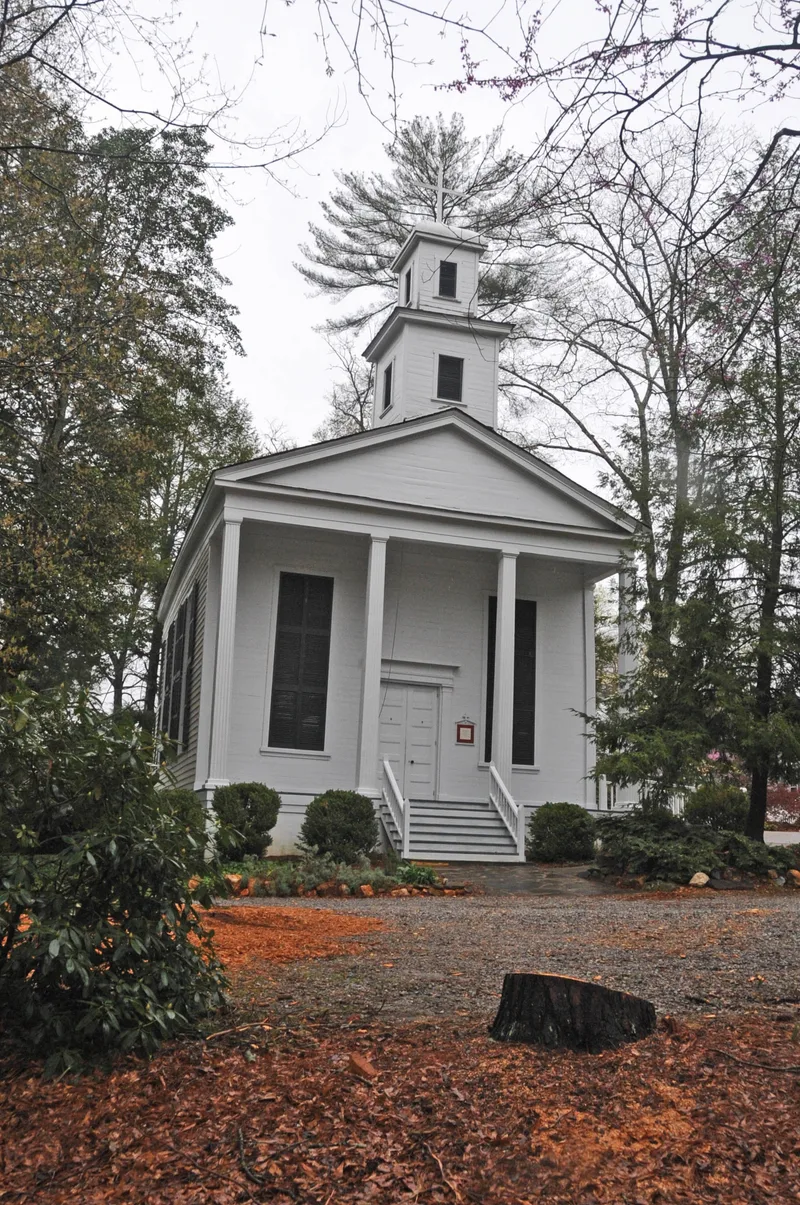
Grace Church is a Greek Revival frame church on the corner of Wilson and Greene Streets in Clarkesville, Georgia, one block from the town's business district. Built in 1839-42 with mortise-and-tenon construction, it has a two-story portico with four square columns, tall multi-paned windows with original hand-blown glass, and a two-part belfry holding a bell cast in 1852. Inside, box pews of handhewn pine, a rear balcony and a central pulpit remain as first built. The congregation began in 1838 among summer visitors escaping the coastal heat. Architect Jarvis Van Buren, also known for work with Georgia fruit, designed it. The church was the sixth Episcopal congregation in Georgia, and in 1840 Stephen Elliott Jr. was elected there as the state's first Episcopal bishop. Its 1845 tracker-action organ was built by Henry Erben, a leading nineteenth-century organ builder. Only electricity and foundation fill have altered the building, which is still in use.
Significance in brief: The nomination calls it the oldest Episcopal church in Georgia that remains essentially unaltered, and a good example of Greek Revival church architecture. It was the sixth Episcopal church established in Georgia, and the state's first bishop was elected there in 1840. Its 1845 tracker-action organ by Henry Erben adds musical significance.
Machine-generated summary. This summary was generated by a language model from the official nomination document and has not been reviewed line by line by an editor. It may contain errors. Check the source document before relying on any detail. Source: nomination document (PDF) · National Archives catalog entry. NRHP reference 80001087, listed February 15, 1980. Summary generated October 2026 (model claude-sonnet-5-5, prompt v1.0-2026-10-29, confidence high).
Key facts
| Address | Wilson and Greene Sts., Clarkesville |
|---|---|
| County | Habersham County |
| Listed | February 15, 1980 |
| Reference number | 80001087 |
| Resource type | Building |
| Period of significance | 1800-1899 (specific dates 1839-42) |
| Architect / builder | Jarvis Van Buren |
| Architectural style | Greek Revival |
| Areas of significance | Architecture, Religion, Performing Arts |
| Level of significance | State |
| Status (as stated in the nomination) | Occupied and in religious use; the church is in excellent condition. It was restored in 1975, and a 1950 parish hall (enlarged 1978) is noncontributing. |
| Acreage | 0.9 |
| Coordinates | 34.61611, -83.52311 (NPS GIS) |
What listing means for this property
Religious properties are listed for their architectural or historical significance, not their religious use. Listing is honorary and does not restrict the congregation's use of the building. The federal rehabilitation credit is generally unavailable unless part of the building is income-producing; some state programmes and preservation grants do cover religious buildings. Federal funding or permits trigger Section 106 review.
General information, not legal or tax advice. Rules change; confirm with your State Historic Preservation Office or a qualified adviser.
Sources and further reading
- National Park Service, National Register of Historic Places database (snapshot May 2026), reference 80001087.
- Nomination form (PDF, National Archives) — catalog entry
- Wikipedia article (used for cross-checking only; text not reproduced here)
- Wikidata Q55612876
- This listing as JSON
Last updated October 2026. Found an error? See the editorial policy for how to report it.