Jefferson Hall

Why it's listed
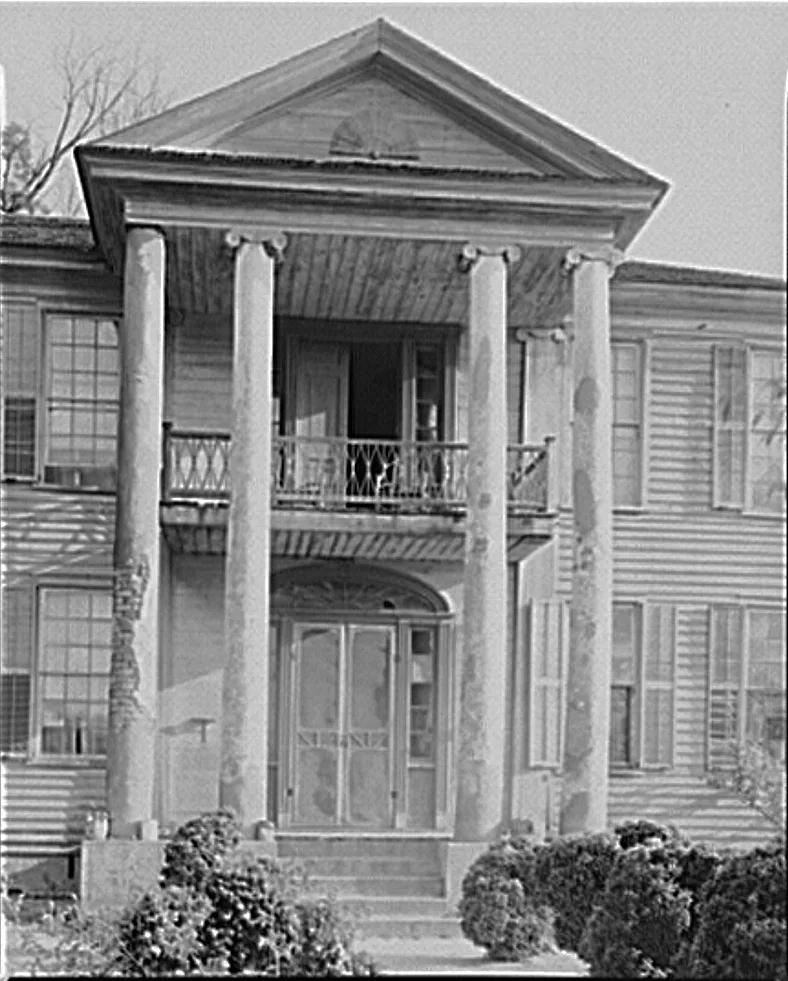
Jefferson Hall is a former cotton plantation about one and a half miles east of Union Point in rural Greene County, Georgia. Its main house, built around 1830 and traditionally credited to Augustine Greene, is a two-story frame building with a central hall, a rear wing and a two-story front portico carried on four brick columns covered in stucco. Fanlighted and sidelighted entrances and Adamesque mantels reflect the Federal style, while the portico shows Early Classical Revival influence. Original pine floors, windows, doors and hand-hewn timber framing survive. A late nineteenth-century tenant house and an early twentieth-century barn recall the shift from slave labor to sharecropping. The property also marks the spot where the Georgia Railroad, the state's first, reached Greene's land in 1838. A village named Jefferson Hall, with stores, an inn and a post office, grew up nearby and later vanished. The house is its only surviving structure and remains in a rural setting.
Significance in brief: The nomination argues the house is a fine, well-preserved example of Federal and Early Classical Revival architecture in Georgia, with a brick-and-stucco Ionic portico. It also represents a cotton plantation that moved from slave labor to sharecropping. Finally, it is the only physical remnant of the railroad community of Jefferson Hall, which grew up when the Georgia Railroad arrived in 1838.
Machine-generated summary. This summary was generated by a language model from the official nomination document and has not been reviewed line by line by an editor. It may contain errors. Check the source document before relying on any detail. Source: nomination document (PDF) · National Archives catalog entry. NRHP reference 89001100, listed August 10, 1989. Summary generated October 2026 (model claude-sonnet-5-5, prompt v1.0-2026-10-29, confidence high).
Key facts
| Address | GA 12, Union Point |
|---|---|
| County | Greene County |
| Listed | August 10, 1989 |
| Reference number | 89001100 |
| Resource type | District |
| Period of significance | 1830-1939 |
| Architect / builder | unknown |
| Architectural style | Federal; Early Classical Revival |
| Criteria |
|
| Areas of significance | Agriculture, Transportation, Exploration/Settlement, Architecture |
| Level of significance | State |
| Status (as stated in the nomination) | Still used as a single dwelling; the tenant house is used for storage. Changes to the house have been minimal. |
| Acreage | 30 |
| Coordinates | 33.60229, -83.03855 (NPS GIS) |
What listing means for this property
This is a historic district. Buildings within its boundary are either contributing (they add to the district's significance) or non-contributing. Owners of contributing income-producing buildings can claim the 20% federal rehabilitation tax credit; homeowners should look at state credits. National Register districts impose no design review by themselves; a local historic district ordinance, if one exists, does (the difference explained).
General information, not legal or tax advice. Rules change; confirm with your State Historic Preservation Office or a qualified adviser.
Sources and further reading
- National Park Service, National Register of Historic Places database (snapshot May 2026), reference 89001100.
- Nomination form (PDF, National Archives) — catalog entry
- Wikipedia article (used for cross-checking only; text not reproduced here)
- Wikidata Q6175479
- This listing as JSON
Last updated October 2026. Found an error? See the editorial policy for how to report it.