Bethesda Baptist Church and Cemetery

Why it's listed
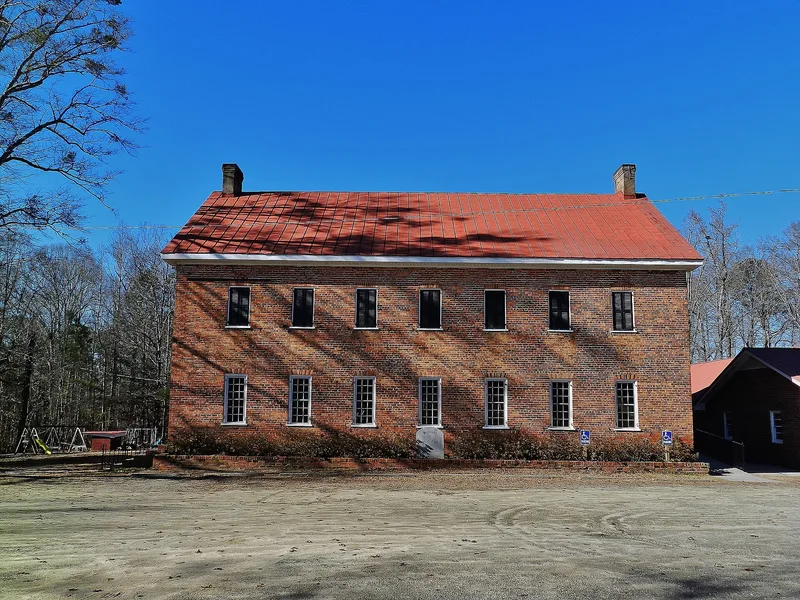
Bethesda Baptist Church and Cemetery occupies 10.75 acres at a rural crossroads in Greene County, Georgia, beside forest land. The centerpiece is a brick church, about 40 by 60 feet, built between 1815 and 1818 from locally made bricks. Its Federal-style features include flat jack arches over doors and windows, gable returns, thin cornices, and a wooden east gallery added in the 1850s. The congregation began in 1785 as Whatley's Mill, and Jesse Mercer, an early Baptist leader, led the dedication service on December 20, 1818. In 1836 the church licensed a Black preacher to minister to the enslaved and other Black residents nearby. The grounds also hold a natural baptismal spring, a brick-and-concrete baptismal pool from 1906, a well, and a cemetery laid out in 1888 to a plan drawn in New York. Later additions include a 1960 classroom wing and a 1974 Sunday School building. It was listed for its early brick architecture and its long Baptist history.
Significance in brief: The nomination argues the church is one of the oldest surviving church buildings in Georgia and among the oldest in brick, with a fine rural example of vernacular Federal architecture. It is also significant in religion because the congregation, organized in 1785, has met continuously on the same site and reflects early Baptist presence in the state.
Machine-generated summary. This summary was generated by a language model from the official nomination document and has not been reviewed line by line by an editor. It may contain errors. Check the source document before relying on any detail. Source: nomination document (PDF) · National Archives catalog entry. NRHP reference 98000967, listed August 6, 1998. Summary generated October 2026 (model claude-sonnet-5-5, prompt v1.0-2026-10-29, confidence high).
Key facts
| Address | Jct. of Cty Rd. 120 and Cty Rd. 129, Union Point |
|---|---|
| County | Greene County |
| Listed | August 6, 1998 |
| Reference number | 98000967 |
| Resource type | Building |
| Period of significance | 1818-1948 |
| Architect / builder | unknown |
| Architectural style | Early Republic: Federal (vernacular Federal) |
| Criteria |
|
| Areas of significance | Architecture, Education |
| Level of significance | State |
| Status (as stated in the nomination) | Well-maintained and in excellent condition; the congregation remains active, with weekly services, and the cemetery is still in use. |
| Acreage | 10.8 |
| Coordinates | 33.65166, -83.01008 (NPS GIS) |
What listing means for this property
Religious properties are listed for their architectural or historical significance, not their religious use. Listing is honorary and does not restrict the congregation's use of the building. The federal rehabilitation credit is generally unavailable unless part of the building is income-producing; some state programmes and preservation grants do cover religious buildings. Federal funding or permits trigger Section 106 review.
General information, not legal or tax advice. Rules change; confirm with your State Historic Preservation Office or a qualified adviser.
Sources and further reading
- National Park Service, National Register of Historic Places database (snapshot May 2026), reference 98000967.
- Nomination form (PDF, National Archives) — catalog entry
- Wikipedia article (used for cross-checking only; text not reproduced here)
- Wikidata Q55605273
- This listing as JSON
Last updated October 2026. Found an error? See the editorial policy for how to report it.