New Echota

Why it's listed
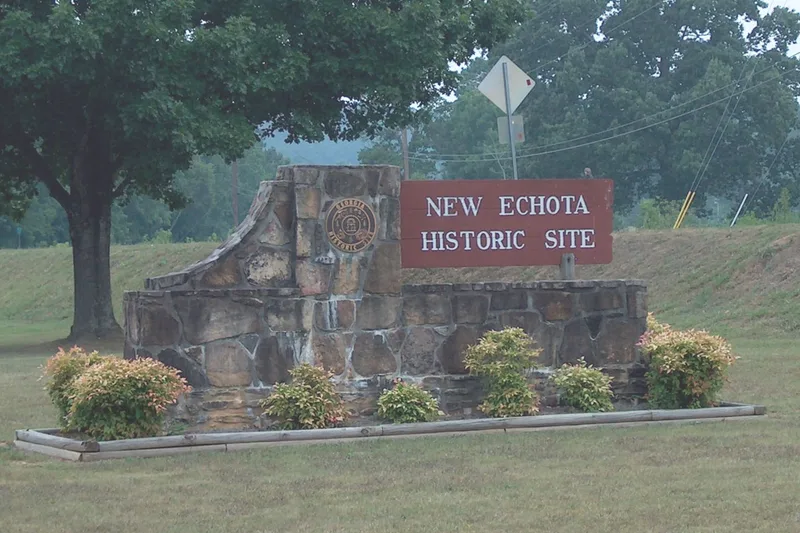
New Echota, near Calhoun in Gordon County, Georgia, is the site of the Cherokee Nation's capital, established in 1825. The village was lost until 1953, when research located it in a corn field near the meeting of the Oostanaula and Coosawattee Rivers. Today the roughly 200-acre property holds the original Worcester House, a c.1827 two-story frame home and mission school, along with a reconstructed Supreme Court building and Print Shop, a moved Cherokee-built tavern and a visitor's center. The place matters for what happened here. The Cherokee adopted a constitution and a republican government, and in 1828 printed the first issue of the Cherokee Phoenix in Cherokee and English using Sequoyah's syllabary. The missionary Samuel Worcester's case, Worcester v. Georgia, grew from events here. In December 1835 a minority faction signed the Treaty of New Echota, which became the pretext for removal, and General Winfield Scott based his command here in 1838.
Significance in brief: New Echota was the first truly national capital of the Cherokee Nation, where its adopted Anglo-American style of government, law and literacy was institutionalized. The Cherokee Phoenix newspaper was printed here in 1828 using Sequoyah's syllabary. It was the setting for Worcester v. Georgia and the place where the 1835 Treaty of New Echota was signed, leading to the Trail of Tears.
Machine-generated summary. This summary was generated by a language model from the official nomination document and has not been reviewed line by line by an editor. It may contain errors. Check the source document before relying on any detail. Source: nomination document (PDF) · National Archives catalog entry. NRHP reference 70000869, listed May 13, 1970. Summary generated October 2026 (model claude-sonnet-5-5, prompt v1.0-2026-10-29, confidence high).
Key facts
| Address | NE of Calhoun on GA 225, Calhoun |
|---|---|
| County | Gordon County |
| Listed | May 13, 1970 |
| Reference number | 70000869 |
| Resource type | District |
| Period of significance | 1825-1838 |
| Architect / builder | Worcester House built by Rev. Samuel A. Worcester (1827); restoration directed by Henry Chandlee Forman; reconstructions directed by Thomas G. Little; Vann's Tavern built by James Vann |
| Areas of significance | Historic - Aboriginal, Native American, Politics/Government, Social History |
| Level of significance | National |
| National Historic Landmark | Yes, designated November 7, 1973 |
| Status (as stated in the nomination) | Condition listed as excellent and altered, on its original site, with preservation work in progress; operated as a public historic site and museum by the Georgia Historical Commission. |
| Acreage | 200 |
| Coordinates | 34.53939, -84.90314 (NPS GIS) |
What listing means for this property
This is a historic district. Buildings within its boundary are either contributing (they add to the district's significance) or non-contributing. Owners of contributing income-producing buildings can claim the 20% federal rehabilitation tax credit; homeowners should look at state credits. National Register districts impose no design review by themselves; a local historic district ordinance, if one exists, does (the difference explained).
General information, not legal or tax advice. Rules change; confirm with your State Historic Preservation Office or a qualified adviser.
Sources and further reading
- National Park Service, National Register of Historic Places database (snapshot May 2026), reference 70000869.
- Nomination form (PDF, National Archives) — catalog entry
- Wikipedia article (used for cross-checking only; text not reproduced here)
- Wikidata Q7007061
- This listing as JSON
Last updated October 2026. Found an error? See the editorial policy for how to report it.