Horton-duBignon House, Brewery Ruins, duBignon Cemetery

Why it's listed
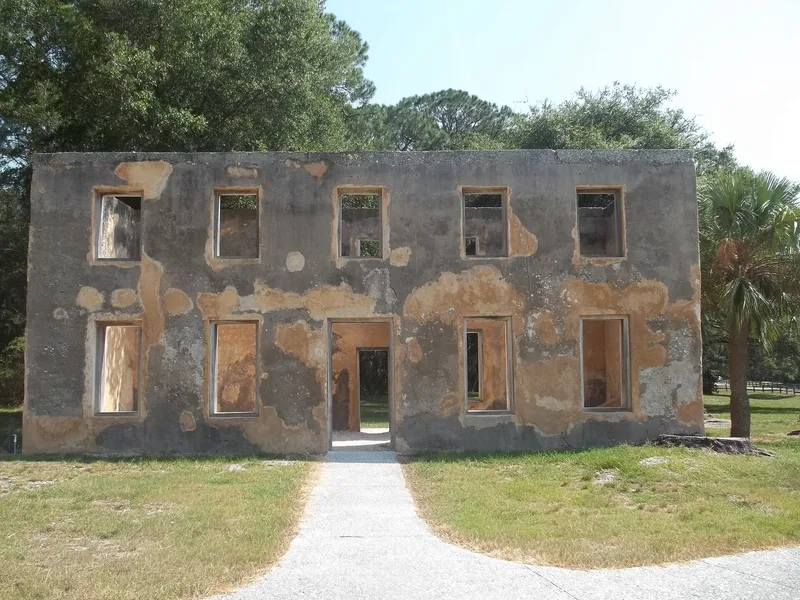
Along Riverview Drive on Jekyll Island stand the remains of an early English outpost: a roofless two-story tabby house, the crumbling walls of a brewery, and a small family cemetery. Major William Horton built the house and brewery around 1736 on the orders of General James Oglethorpe, who wanted a military presence on the island. Horton's brewery, the first in Georgia, supplied soldiers at Fort Frederica on Saint Simons Island. The Spanish burned the house in 1742. From 1791 the island belonged to the duBignon family, French refugees who repaired the house and grew indigo and Sea Island cotton. Family members were buried in the cemetery, and the Civil War ended the plantation economy. Later, Jekyll Island Club members braced the ruins and walled the cemetery. The state bought the island in 1947. The three sites form a district that preserves the island's military and plantation past, in contrast to the nearby club complex.
Significance in brief: The sites mark the pre-Jekyll Island Club era, beginning with Major William Horton's 1730s English military outpost and Georgia's first brewery. They also reflect the later duBignon family plantation period, from 1791 to 1886. Together they show different phases of the island's history, from military outpost to cotton plantation to millionaires' club.
Machine-generated summary. This summary was generated by a language model from the official nomination document and has not been reviewed line by line by an editor. It may contain errors. Check the source document before relying on any detail. Source: nomination document (PDF) · National Archives catalog entry. NRHP reference 71000278, listed September 28, 1971. Summary generated October 2026 (model claude-sonnet-5-5, prompt v1.0-2026-10-29, confidence medium).
Key facts
| Address | Riverview Dr., Jekyll Island |
|---|---|
| County | Glynn County |
| Listed | September 28, 1971 |
| Reference number | 71000278 |
| Resource type | District |
| Architect / builder | Major William Horton (house and brewery) |
| Areas of significance | Industry, Agriculture, Military, Architecture, Social History |
| Level of significance | National |
| Status (as stated in the nomination) | Described as deteriorated ruins: the house is a two-story tabby shell with its roof and upper floor gone, and the brewery survives as crumbling tabby sections. The property is state-owned and used as park land. |
| Acreage | 9.9 |
| Coordinates | 31.10176, -81.41456 (NPS GIS) |
What listing means for this property
This is a historic district. Buildings within its boundary are either contributing (they add to the district's significance) or non-contributing. Owners of contributing income-producing buildings can claim the 20% federal rehabilitation tax credit; homeowners should look at state credits. National Register districts impose no design review by themselves; a local historic district ordinance, if one exists, does (the difference explained).
General information, not legal or tax advice. Rules change; confirm with your State Historic Preservation Office or a qualified adviser.
Sources and further reading
- National Park Service, National Register of Historic Places database (snapshot May 2026), reference 71000278.
- Nomination form (PDF, National Archives) — catalog entry
- Wikipedia article (used for cross-checking only; text not reproduced here)
- Wikidata Q14686663
- This listing as JSON
Last updated October 2026. Found an error? See the editorial policy for how to report it.