Whittier Mills Historic District

Why it's listed
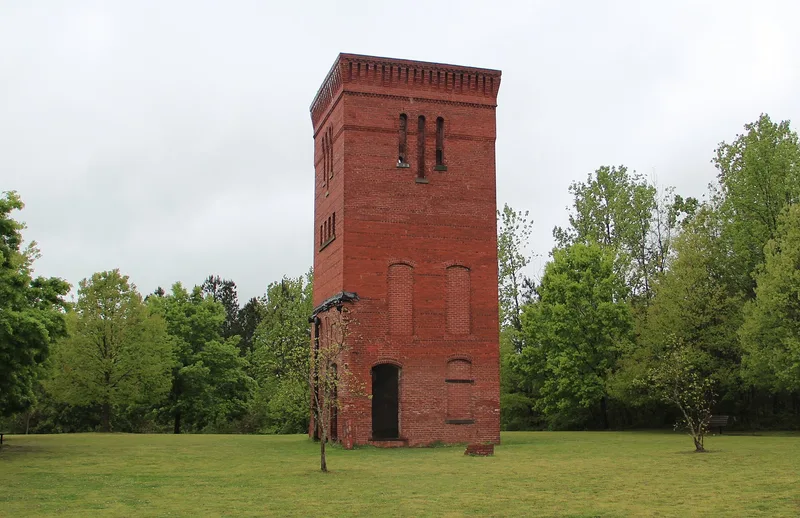
Whittier Mills Historic District is a former cotton mill village on the south bank of the Chattahoochee River, about seven miles northwest of downtown Atlanta. Whittier Cotton Mills of Lowell, Massachusetts began building the mill and thirty wood-framed workers' cottages in 1895, and production started in 1896. The company platted the streets, rented out housing, and later added a church, school, settlement house and health facilities. A 1926 expansion with the Silver Lake Company brought 36 more dwellings, designed by the Boston firm Parsons and Wait, and a final subdivision followed in 1957. The mill buildings were demolished in the 1980s, but a brick tower and storehouse walls survive. The remaining resources include one-story duplexes and triplexes, superintendents' houses, a 1942 brick church and a 1948 Art Moderne health center. The district is recognized for its company-planned village, its industrial role in the New South, and its mill housing, which retains good integrity.
Significance in brief: The district is significant under Criterion A for social history, community planning and development, and industry, as a company-built mill complex and village where the mill company controlled housing, services and welfare. Under Criterion C it is significant for its mill village housing and superintendents' single-family houses. The period of significance runs from the 1895 founding to the last company expansion in 1957.
Machine-generated summary. This summary was generated by a language model from the official nomination document and has not been reviewed line by line by an editor. It may contain errors. Check the source document before relying on any detail. Source: nomination document (PDF) · National Archives catalog entry. NRHP reference 01000972, listed September 13, 2001. Summary generated October 2026 (model claude-sonnet-5-5, prompt v1.0-2026-10-29, confidence high).
Key facts
| Address | Roughly the jct. of Bolton Rd. and Parrot Ave., approx. 7 mi. NW of central business district of Atlanta, Atlanta |
|---|---|
| County | Fulton County |
| Listed | September 13, 2001 |
| Reference number | 01000972 |
| Resource type | District |
| Period of significance | 1895-1957 |
| Architect / builder | Parsons and Wait, Boston, Massachusetts, Architects |
| Architectural style | Colonial Revival; Bungalow/Craftsman; Georgian cottage; Queen Anne cottage; Gable-ell cottage |
| Criteria |
|
| Areas of significance | Architecture, Community Planning and Development, Industry, Social History |
| Level of significance | Local |
| Status (as stated in the nomination) | The mill buildings were demolished in the 1980s; a three-story brick tower and storehouse walls remain on the mill site. The village houses are now single dwellings, and many have been altered since the 1950s. |
| Acreage | 30 |
| Coordinates | 33.81188, -84.48318 (NPS GIS) |
What listing means for this property
This is a historic district. Buildings within its boundary are either contributing (they add to the district's significance) or non-contributing. Owners of contributing income-producing buildings can claim the 20% federal rehabilitation tax credit; homeowners should look at state credits. National Register districts impose no design review by themselves; a local historic district ordinance, if one exists, does (the difference explained).
General information, not legal or tax advice. Rules change; confirm with your State Historic Preservation Office or a qualified adviser.
Sources and further reading
- National Park Service, National Register of Historic Places database (snapshot May 2026), reference 01000972.
- Nomination form (PDF, National Archives) — catalog entry
- Wikipedia article (used for cross-checking only; text not reproduced here)
- Wikidata Q7996876
- This listing as JSON
Last updated October 2026. Found an error? See the editorial policy for how to report it.