East Point Industrial District

Why it's listed
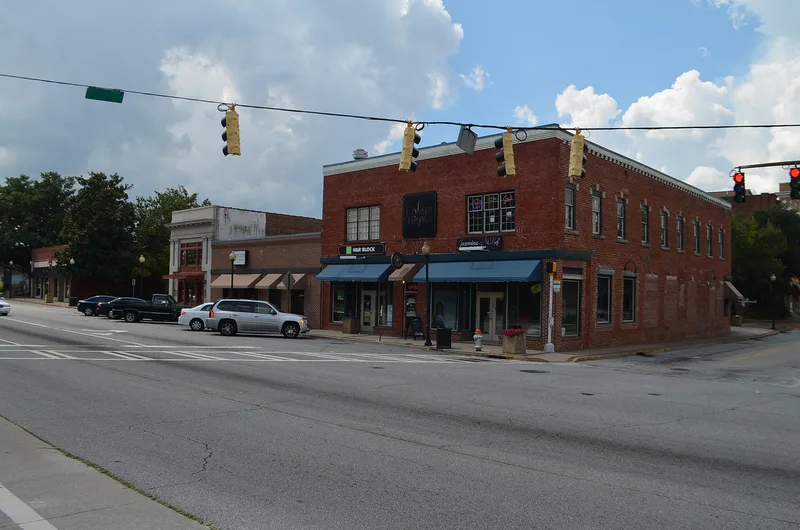
Five former factory complexes stand beside the Central of Georgia Railroad in downtown East Point, Georgia, forming an industrial district of about 30 acres. They are the White Hickory Wagon Works (1884), the Blount Carriage and Buggy Works and Couch Brothers Manufacturing (both around 1907), the Atlanta Utility Works, and the Oak Knitting Mill (early 1920s). Most are rectangular brick buildings with large segmental-arched windows and heavy timber interior framing, while the largest knitting mill building uses reinforced concrete with brick infill. Together they show how East Point developed as a suburban manufacturing center outside Atlanta, making wagons, buggies, cotton products, fertilizer and farm machinery. Many workers, including residents of South Atlanta, commuted by train or trolley. Production of horse-drawn vehicles faded in the 1920s as motor vehicles took over. The district also reflects the influence of John J. Egan, who developed much of East Point east of the tracks. Later additions and a transit overpass have altered the setting, but the historic buildings remain intact.
Significance in brief: The district is significant for architecture, industry and local history. Its brick factories with segmental-arched windows and heavy timber interiors are good examples of late 19th-century southeastern industrial design, and one building shows early reinforced-concrete construction. It also records East Point's growth as a railroad-based suburban industrial center outside Atlanta, and it is tied to factory owners and to John J. Egan, who developed much of the town.
Machine-generated summary. This summary was generated by a language model from the official nomination document and has not been reviewed line by line by an editor. It may contain errors. Check the source document before relying on any detail. Source: nomination document (PDF) · National Archives catalog entry. NRHP reference 85001971, listed September 5, 1985. Summary generated October 2026 (model claude-sonnet-5-5, prompt v1.0-2026-10-29, confidence high).
Key facts
| Address | Roughly bounded by Martin and Taylor Sts. Norman Berry Dr. and RR tracks, East Point |
|---|---|
| County | Fulton County |
| Listed | September 5, 1985 |
| Reference number | 85001971 |
| Resource type | District |
| Period of significance | 1884-1935 |
| Architect / builder | John J. Egan |
| Architectural style | Late 19th- and early 20th-century industrial and warehouse architecture; early 20th-century reinforced-concrete construction |
| Areas of significance | Industry, Architecture |
| Level of significance | Local |
| Status (as stated in the nomination) | Most buildings are altered or have non-historic additions, and the Atlanta Utility Works is the exception. Condition is rated good to fair. Some buildings are in other commercial or warehouse use, and a MARTA overpass intrudes on the district. |
| Acreage | 30 |
| Coordinates | 33.68045, -84.43874 (NPS GIS) |
What listing means for this property
This is a historic district. Buildings within its boundary are either contributing (they add to the district's significance) or non-contributing. Owners of contributing income-producing buildings can claim the 20% federal rehabilitation tax credit; homeowners should look at state credits. National Register districts impose no design review by themselves; a local historic district ordinance, if one exists, does (the difference explained).
General information, not legal or tax advice. Rules change; confirm with your State Historic Preservation Office or a qualified adviser.
Sources and further reading
- National Park Service, National Register of Historic Places database (snapshot May 2026), reference 85001971.
- Nomination form (PDF, National Archives) — catalog entry
- Wikidata Q141760367
- This listing as JSON
Last updated October 2026. Found an error? See the editorial policy for how to report it.