Sardis Presbyterian Church and Cemetery

Why it's listed
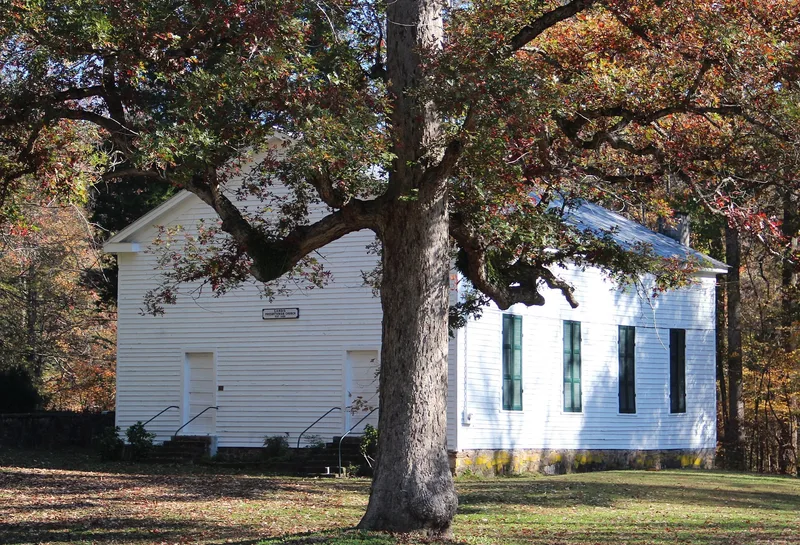
Sardis Presbyterian Church and Cemetery occupy 6.2 acres at the southern foot of Turnip Mountain in rural Floyd County, Georgia. The church, finished in 1855, is a one-story, wood-framed, clapboard building with a gabled front, a stone foundation, two entrance doors and a single large interior room. Original pine pews, a pine pulpit, wrought iron kerosene chandeliers and a silver communion service survive. Next to it lies a public cemetery begun in 1836 with about 235 burials, enclosed by a rare four-foot stone wall. Its marble and granite markers include the matching monuments of two Bale brothers, Confederate officers killed in the Civil War. The congregation formed just after the Cherokee were removed from the area, and the site may have hosted an earlier Presbyterian mission to them. The property was listed for its role in early settlement, its intact rural church architecture, and the artistry of its grave markers.
Significance in brief: The nomination argues it is one of the oldest Presbyterian congregations in northwest Georgia, tied to an early Presbyterian mission to the Cherokee and to settlement after Cherokee removal. The church is an intact antebellum rural church, and the cemetery has varied tombstones and a rare early stone wall.
Machine-generated summary. This summary was generated by a language model from the official nomination document and has not been reviewed line by line by an editor. It may contain errors. Check the source document before relying on any detail. Source: nomination document (PDF) · National Archives catalog entry. NRHP reference 04001468, listed January 12, 2005. Summary generated October 2026 (model claude-sonnet-5-5, prompt v1.0-2026-10-29, confidence high).
Key facts
| Address | 7104 GA 20 NW, Coosa |
|---|---|
| County | Floyd County |
| Listed | January 12, 2005 |
| Reference number | 04001468 |
| Resource type | District |
| Period of significance | 1836-1954 |
| Architect / builder | Unknown |
| Architectural style | Other: No Style (vernacular rural folk church with gable-front form reminiscent of Greek Revival) |
| Criteria |
|
| Areas of significance | Architecture, Art, Exploration/Settlement, Religion |
| Level of significance | State |
| Status (as stated in the nomination) | No longer houses an active congregation; the church is maintained by the Sardis Preservation Society and remains relatively intact. The cemetery is still in use. |
| Acreage | 6.2 |
| Coordinates | 34.26537, -85.37802 (NPS GIS) |
What listing means for this property
This is a historic district. Buildings within its boundary are either contributing (they add to the district's significance) or non-contributing. Owners of contributing income-producing buildings can claim the 20% federal rehabilitation tax credit; homeowners should look at state credits. National Register districts impose no design review by themselves; a local historic district ordinance, if one exists, does (the difference explained).
General information, not legal or tax advice. Rules change; confirm with your State Historic Preservation Office or a qualified adviser.
Sources and further reading
- National Park Service, National Register of Historic Places database (snapshot May 2026), reference 04001468.
- Nomination form (PDF, National Archives) — catalog entry
- Wikipedia article (used for cross-checking only; text not reproduced here)
- Wikidata Q14686820
- This listing as JSON
Last updated October 2026. Found an error? See the editorial policy for how to report it.