Rolator Park Historic District

Why it's listed
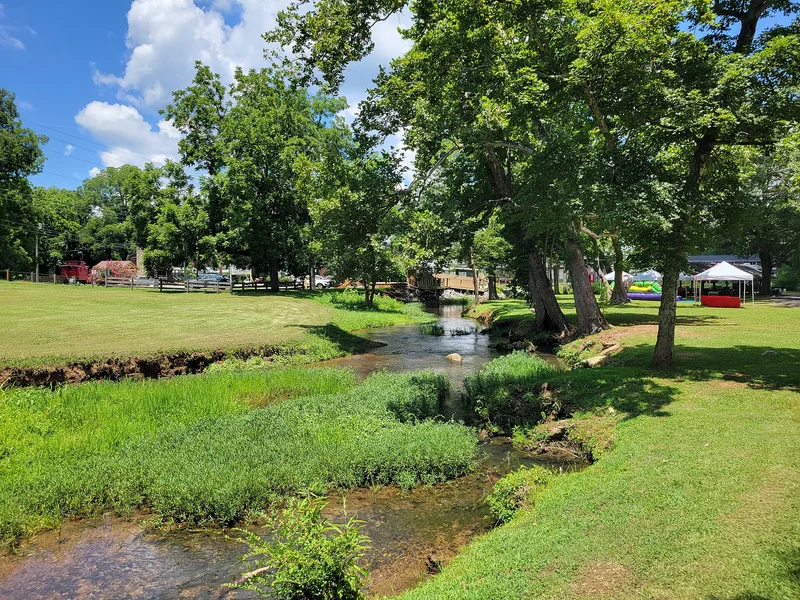
Rolator Park is a roughly 27-acre public park and nature preserve in the southeast part of Cave Spring, Georgia. Its grounds run along the floodplain between Little Cedar Creek and a spring that flows from a cave, with wooded hillside to the southeast. A pond, a swimming pool and a rustic stone springhouse built by the W.P.A. add to the setting. Three older buildings stand together on the floodplain: a brick Greek Revival Baptist church from 1851 and two early-twentieth-century Neoclassical wood-frame buildings, a classroom and a dormitory, from Hearn Academy. The Baptist church founded the academy in 1838 as the town's first school, buying 680 acres for it, and the school occupied the site until 1926. The park holds the only intact acreage from that venture. The land was later donated to the city for public use. The district is recognized for its architecture, informal landscape design, educational history and religious history.
Significance in brief: The district is significant for architecture, landscape architecture, education and religion. It holds a Greek Revival brick Baptist church from 1851, two early-twentieth-century Neoclassical Hearn Academy buildings and a rustic W.P.A. springhouse. It is the city's largest public park and the only intact acreage of the site of Cave Spring's first school, founded by the Baptist church in 1838.
Machine-generated summary. This summary was generated by a language model from the official nomination document and has not been reviewed line by line by an editor. It may contain errors. Check the source document before relying on any detail. Source: nomination document (PDF) · National Archives catalog entry. NRHP reference 80001055, listed June 19, 1980. Summary generated October 2026 (model claude-sonnet-5-5, prompt v1.0-2026-10-29, confidence medium).
Key facts
| Address | Off U.S. 411, Cave Spring |
|---|---|
| County | Floyd County |
| Listed | June 19, 1980 |
| Reference number | 80001055 |
| Resource type | District |
| Architectural style | Greek Revival (church); Neoclassical (classroom building and dormitory); rustic/picturesque park architecture (springhouse) |
| Areas of significance | Landscape Architecture, Education, Architecture |
| Level of significance | Local |
| Status (as stated in the nomination) | Operated as a public park owned by the city; the park land was donated to the city in the 1930s. |
| Acreage | 27 |
| Coordinates | 34.10259, -85.33514 (NPS GIS) |
What listing means for this property
This is a historic district. Buildings within its boundary are either contributing (they add to the district's significance) or non-contributing. Owners of contributing income-producing buildings can claim the 20% federal rehabilitation tax credit; homeowners should look at state credits. National Register districts impose no design review by themselves; a local historic district ordinance, if one exists, does (the difference explained).
General information, not legal or tax advice. Rules change; confirm with your State Historic Preservation Office or a qualified adviser.
Sources and further reading
- National Park Service, National Register of Historic Places database (snapshot May 2026), reference 80001055.
- Nomination form (PDF, National Archives) — catalog entry
- Wikidata Q141757805
- This listing as JSON
Last updated October 2026. Found an error? See the editorial policy for how to report it.