Carnes, John Thomas, Family Log House
Also known as: Clinton Farm; Clinton Nature Preserve

Why it's listed
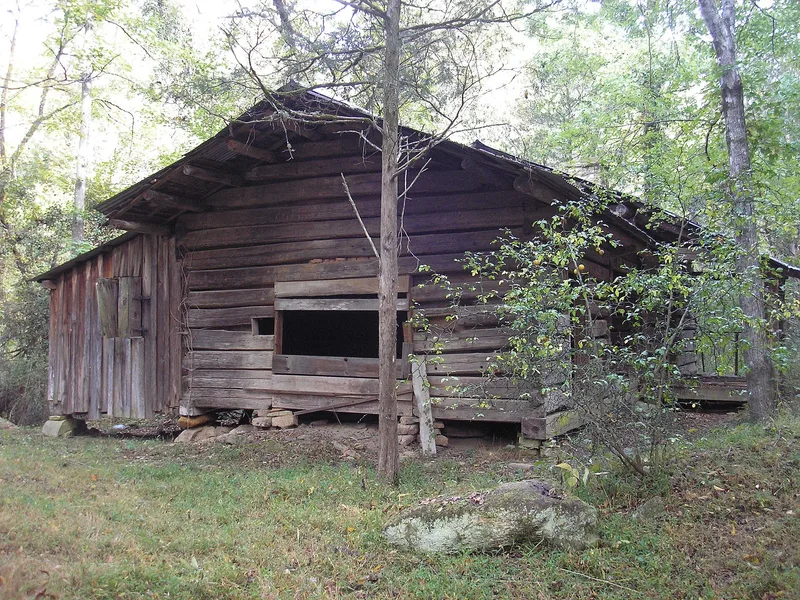
Built around 1828, this hand-hewn log dogtrot house in western Douglas County, Georgia, has two unequal rooms divided by an open passage. It has half-dovetail corner notching, mostly unchinked logs, fieldstone chimneys, stone pier foundations, plank floors and a narrow stair to a loft. A double-pen hay barn and a log stock barn remain nearby, along with a stacked-stone retaining wall and a spring enclosure. John Thomas Carnes settled here shortly after the 1827 Land Lottery opened the area, and he and his wife Mary raised a large family on a farm that grew to about 700 acres. The land stayed in the family until Annie Clinton's death in 1983, when half passed to Douglas County as a nature preserve. The house is considered rare among surveyed Georgia properties because few log dogtrot dwellings survive, and it remains on its original site. A 2001 grant project repaired the structures, which are vacant and open to limited public visits.
Significance in brief: It is argued to be significant in architecture as an intact, rare 19th-century log dogtrot house still on its original site. It is also significant in exploration and settlement as a frontier farmstead built after the 1827 Land Lottery. The nomination meets Criteria A and C at the statewide level.
Machine-generated summary. This summary was generated by a language model from the official nomination document and has not been reviewed line by line by an editor. It may contain errors. Check the source document before relying on any detail. Source: nomination document (PDF) · National Archives catalog entry. NRHP reference 01000762, listed July 25, 2001. Summary generated October 2026 (model claude-sonnet-5-5, prompt v1.0-2026-10-29, confidence high).
Key facts
| Address | Clinton Nature Preservem 8270 Ephesus Church Rd., Winston |
|---|---|
| County | Douglas County |
| Listed | July 25, 2001 |
| Reference number | 01000762 |
| Resource type | Building |
| Period of significance | c.1828-1869 |
| Architectural style | OTHER: dogtrot house (no academic style) |
| Criteria |
|
| Areas of significance | Architecture, Exploration/Settlement |
| Level of significance | State |
| Status (as stated in the nomination) | The house and outbuildings are vacant. A grant project completed in 2001 stabilized and repaired them, and the county manages the site for limited public access. |
| Acreage | 17 |
| Coordinates | 33.70490, -84.87556 (NPS GIS) |
What listing means for this property
National Register listing is honorary for a privately owned home: it does not by itself restrict what an owner may do with their own money, and it does not require public access. Restrictions come from local landmark or historic-district ordinances, which are separate (how they differ).
Owner-occupied houses are not eligible for the 20% federal rehabilitation tax credit, which applies to income-producing buildings, but many states offer credits for homeowners. Listing also opens the door to preservation easements and to buying a plaque. Start with what listing means for homeowners, renovating a listed house and selling one.
Noted as vacant in the nomination. Nomination documents can be decades old; current status may differ. If you are considering buying an empty listed property, read the due-diligence checklist.
General information, not legal or tax advice. Rules change; confirm with your State Historic Preservation Office or a qualified adviser.
Sources and further reading
- National Park Service, National Register of Historic Places database (snapshot May 2026), reference 01000762.
- Nomination form (PDF, National Archives) — catalog entry
- Wikidata Q134527406
- This listing as JSON
Last updated October 2026. Found an error? See the editorial policy for how to report it.