Beulah Grove Lodge No. 372, Free and Accepted York Masons-Pleasant Grove School
Also known as: Pleasant Grove Colored School

Why it's listed
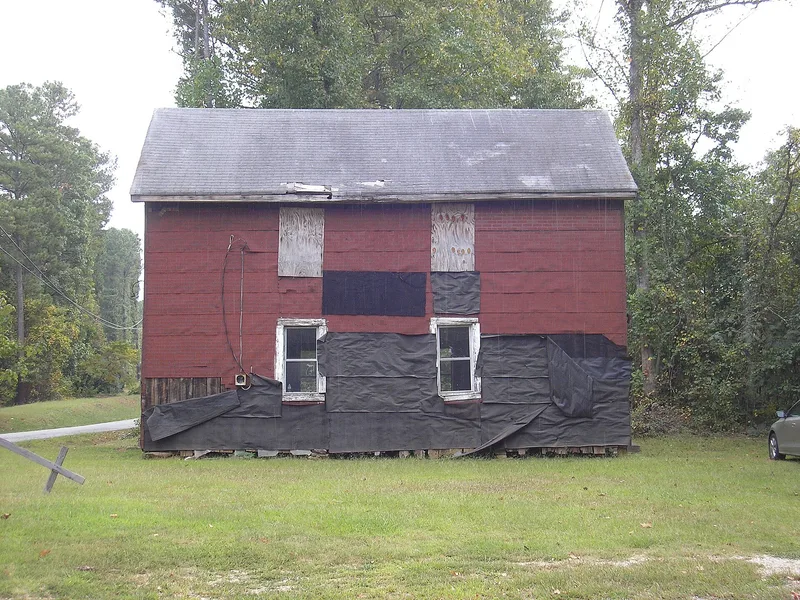
Built around 1910 near Douglasville, this two-story wooden building served a rural African-American community as both a school and a Masonic lodge. Children were taught on the first floor, while Beulah Grove Lodge No. 372 and the Order of the Eastern Star met upstairs. Lodge members and Pleasant Grove Baptist Church members built it, with area builder John Love leading the effort. It sits on stacked-rock foundations with hand-hewn joists, and red tarpaper was added over the vertical board siding in 1962. Inside, the first floor keeps its flushboard walls and ceiling, and two lodge benches remain. Classes ran until the mid-1930s, and lodge use continued into the 1950s. Later the church used it as fellowship hall space and then for storage. It was listed for its role in education, ethnic heritage, social history and architecture, as an example of the church- and lodge-supported schools that served Black children in rural Georgia.
Significance in brief: It is argued to be locally significant under Criterion A for its role as an educational and social center for a rural African-American community during segregation. Under Criterion C it is a good local example of a rural lodge-and-school building that retains most of its original materials and character-defining features.
Machine-generated summary. This summary was generated by a language model from the official nomination document and has not been reviewed line by line by an editor. It may contain errors. Check the source document before relying on any detail. Source: nomination document (PDF) · National Archives catalog entry. NRHP reference 09001301, listed February 3, 2010. Summary generated October 2026 (model claude-sonnet-5-5, prompt v1.0-2026-10-29, confidence high).
Key facts
| Address | 2525 Old Lower River Rd., Douglasville |
|---|---|
| County | Douglas County |
| Listed | February 3, 2010 |
| Reference number | 09001301 |
| Resource type | Building |
| Period of significance | c.1910-1959 |
| Architectural style | No style |
| Criteria |
|
| Areas of significance | Architecture, Education, Black, Social History |
| Level of significance | Local |
| Status (as stated in the nomination) | Current function listed as work in progress; the building was used as church fellowship hall space from 1975 to 1998 and for storage since then. The stairs to the second floor are no longer extant. |
| Acreage | 0.9 |
| Coordinates | 33.70784, -84.65755 (NPS GIS) |
What listing means for this property
For a publicly owned building or structure, listing mainly matters when federal funds, permits or licences are involved: projects then go through Section 106 review so effects on the property are considered. Listing also strengthens applications for preservation grants and, for leased income-producing uses, can enable the federal rehabilitation tax credit.
General information, not legal or tax advice. Rules change; confirm with your State Historic Preservation Office or a qualified adviser.
Sources and further reading
- National Park Service, National Register of Historic Places database (snapshot May 2026), reference 09001301.
- Nomination form (PDF, National Archives) — catalog entry
- Wikipedia article (used for cross-checking only; text not reproduced here)
- Wikidata Q55605297
- This listing as JSON
Last updated October 2026. Found an error? See the editorial policy for how to report it.