Grantville Historic District
Why it's listed
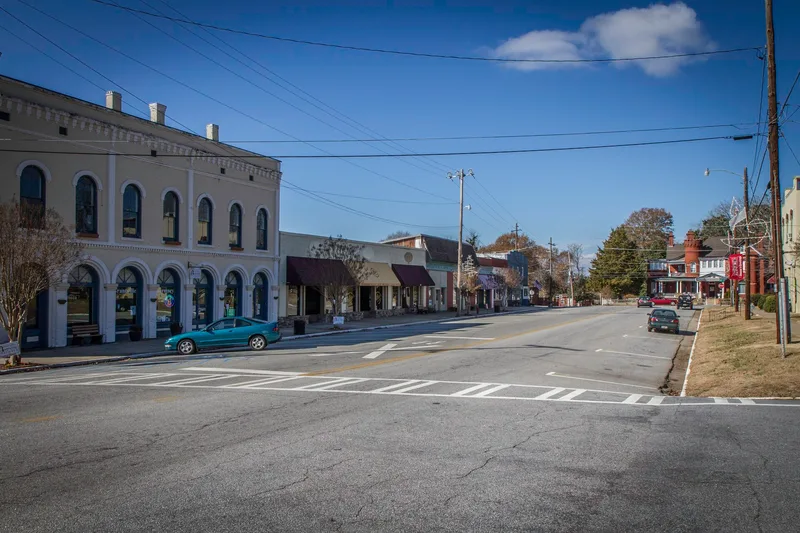
Grantville, in Coweta County, Georgia, is recorded as a historic district that takes in virtually the whole town. The railroad runs through its center, and attached brick storefronts with corbeled details sit on either side of the tracks, along with an 1896 passenger depot and a freight depot. Wood-framed houses spread outward, ranging from Gothic Revival and Victorian homes to Craftsman bungalows and modest mill-village dwellings. Two brick textile mill complexes, one dating from about 1895 and one from 1903, anchor the industrial side. The district also holds several churches, a 1937 Public Works Administration school, a 1927 gymnasium, the waterworks and a city cemetery. Its importance lies in how clearly it shows a small Georgia town growing up around the railroad, which arrived in 1852 and gave the town its name. Development continued through the early 1940s, and 225 buildings contribute to the district's character.
Significance in brief: The district is presented as a nearly intact railroad-oriented small Georgia town that grew after the railroad arrived in 1852. It is significant for architecture, commerce, community planning and development, industry and transportation. It qualifies under Criteria A and C for its development pattern and its range of building types and styles.
Machine-generated summary. This summary was generated by a language model from the official nomination document and has not been reviewed line by line by an editor. It may contain errors. Check the source document before relying on any detail. Source: nomination document (PDF) · National Archives catalog entry. NRHP reference 91000772, listed June 14, 1991. Summary generated October 2026 (model claude-sonnet-5-5, prompt v1.0-2026-10-29, confidence high).
Key facts
| Address | Bounded by US 29, LaGrange St., W. Grantville Rd. and the city cemetery, Grantville |
|---|---|
| County | Coweta County |
| Listed | June 14, 1991 |
| Reference number | 91000772 |
| Resource type | District |
| Period of significance | 1852-1941 |
| Architectural style | Mid-19th Century Gothic Revival; Late Victorian (Italianate, Queen Anne, Romanesque, Folk Victorian); Bungalow |
| Criteria |
|
| Areas of significance | Industry, Community Planning and Development, Commerce, Transportation, Architecture |
| Level of significance | Local |
| Status (as stated in the nomination) | Current uses include single dwellings, manufacturing, religious buildings, businesses and a cemetery. The district retains a high degree of integrity, and the Grantville Mill remains an employer. |
| Acreage | 192 |
| Coordinates | 33.23919, -84.83384 (NPS GIS) |
What listing means for this property
This is a historic district. Buildings within its boundary are either contributing (they add to the district's significance) or non-contributing. Owners of contributing income-producing buildings can claim the 20% federal rehabilitation tax credit; homeowners should look at state credits. National Register districts impose no design review by themselves; a local historic district ordinance, if one exists, does (the difference explained).
General information, not legal or tax advice. Rules change; confirm with your State Historic Preservation Office or a qualified adviser.
Sources and further reading
- National Park Service, National Register of Historic Places database (snapshot May 2026), reference 91000772.
- Nomination form (PDF, National Archives) — catalog entry
- Wikipedia article (used for cross-checking only; text not reproduced here)
- Wikidata Q49495376
- This listing as JSON
Last updated October 2026. Found an error? See the editorial policy for how to report it.