Ball Ground Historic District

Why it's listed
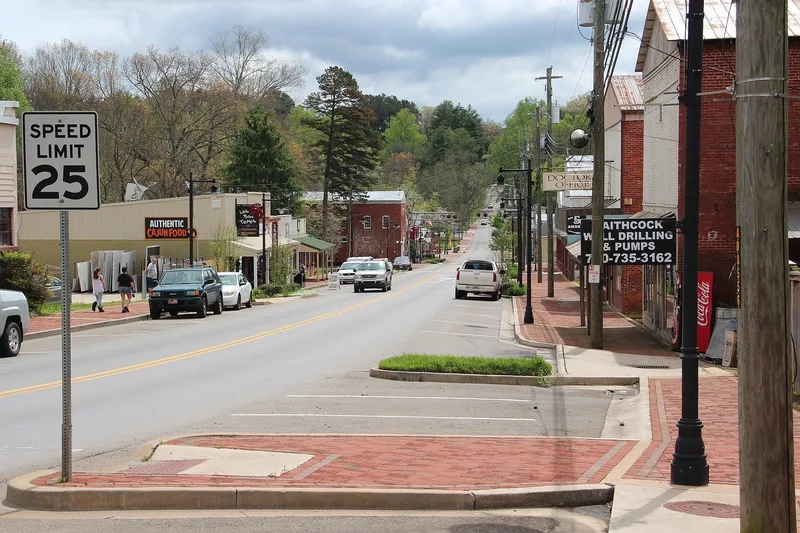
Ball Ground is a small railroad town in the foothills of north Georgia, in northeastern Cherokee County. Its historic district covers a downtown strip along Gilmer Ferry Road and the neighborhoods that fan out from it, with 120 contributing resources. Commercial buildings are mostly one- and two-story brick structures from 1900 to the 1930s, many using marble trim. Houses range from small workers' cottages to large hilltop homes, dating mainly from the 1880s to the 1950s. Community landmarks include the 1923 Roberts Building and Masonic Hall, the 1911 Roberts Store, two churches rebuilt in 1916, an elementary school, cemeteries and the Lion's Club ball field. The town grew after the railroad arrived in 1882 and became a trading center for several surrounding counties. It was best known for marble finishing: by the 1920s four plants cut, polished and carved marble into monuments shipped across the country by rail, employing hundreds of people. That industry shaped the town's layout and buildings.
Significance in brief: The district is described as a relatively intact railroad town that grew after the Marietta and North Georgia Railroad arrived in 1882. Its growth was tied to the marble finishing and monument industry, with four finishing plants by the 1920s, and it became the commercial center of northeastern Cherokee County and nearby counties. Its buildings reflect that commercial, industrial and residential development.
Machine-generated summary. This summary was generated by a language model from the official nomination document and has not been reviewed line by line by an editor. It may contain errors. Check the source document before relying on any detail. Source: nomination document (PDF) · National Archives catalog entry. NRHP reference 09001057, listed December 4, 2009. Summary generated October 2026 (model claude-sonnet-5-5, prompt v1.0-2026-10-29, confidence medium).
Key facts
| Address | Old Canton Rd. and GA 372, Ball Ground |
|---|---|
| County | Cherokee County |
| Listed | December 4, 2009 |
| Reference number | 09001057 |
| Resource type | District |
| Architectural style | Late Victorian (Queen Anne, Italianate), Colonial and Classical Revival, Commercial Style, Bungalow/Craftsman, Moderne, plus vernacular house types such as I-House, Folk Victorian and Georgian Cottage |
| Areas of significance | Architecture, Commerce, Community Planning and Development |
| Level of significance | Local |
| Status (as stated in the nomination) | Commercial buildings are largely intact at street level, though many have non-historic metal roof caps or sheeting; the train depot is no longer extant. Many buildings remain in use as stores, homes, churches and a school. |
| Acreage | 145 |
| Coordinates | 34.34089, -84.37949 (NPS GIS) |
What listing means for this property
This is a historic district. Buildings within its boundary are either contributing (they add to the district's significance) or non-contributing. Owners of contributing income-producing buildings can claim the 20% federal rehabilitation tax credit; homeowners should look at state credits. National Register districts impose no design review by themselves; a local historic district ordinance, if one exists, does (the difference explained).
General information, not legal or tax advice. Rules change; confirm with your State Historic Preservation Office or a qualified adviser.
Sources and further reading
- National Park Service, National Register of Historic Places database (snapshot May 2026), reference 09001057.
- Nomination form (PDF, National Archives) — catalog entry
- Wikipedia article (used for cross-checking only; text not reproduced here)
- Wikidata Q56290675
- This listing as JSON
Last updated October 2026. Found an error? See the editorial policy for how to report it.