Chatahoochee County Jail

Why it's listed
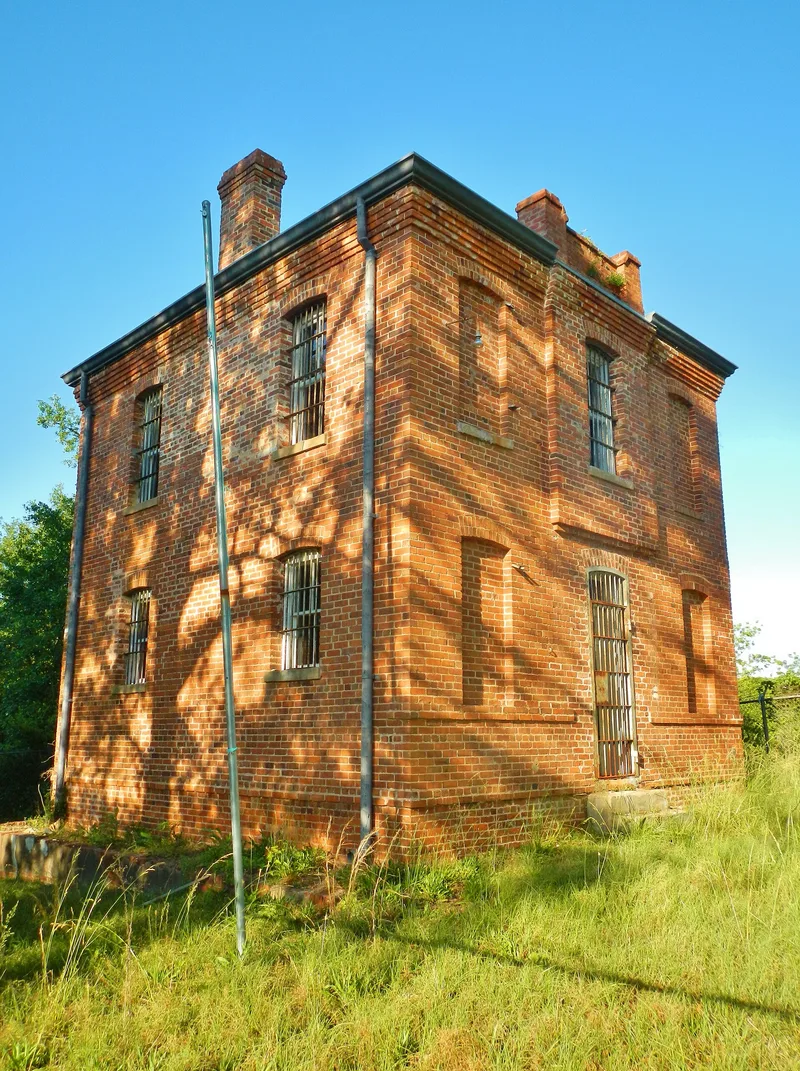
Built in 1902, this two-story brick jail in Cusseta served Chattahoochee County as its only jail until 1975. The county contracted with the Pauly Jail and Manufacturing Company of St. Louis, Missouri, to build it for $5,000, replacing a wooden jail completed in 1855. A new structure was needed because of occasional overcrowding, the desire for a fireproof building, and a trend toward more humane penal facilities. The jail has a steel and concrete interior, plaster-over-brick walls, and arched openings showing Romanesque influence. It keeps its original prefabricated iron cells patented in 1874, steel plate doors and a large plate lock. Unlike many jails of its era, it had no residence for the jailer or sheriff and never had a kitchen. It is significant for its architecture and for its role in local law and government during a period of penal reform in Georgia. The building is now vacant, and adaptive use as a museum and records repository is under consideration.
Significance in brief: The jail is a good example of a small-county-seat jail of the turn of the century, with brick construction, compact massing and Romanesque-influenced detailing. It differs from many Georgia jails in having no living quarters for the jailer or sheriff and no kitchen. It was also the county's second jail and its first fireproof one, and served as the only county jail from 1902 until 1975.
Machine-generated summary. This summary was generated by a language model from the official nomination document and has not been reviewed line by line by an editor. It may contain errors. Check the source document before relying on any detail. Source: nomination document (PDF) · National Archives catalog entry. NRHP reference 86000368, listed March 13, 1986. Summary generated October 2026 (model claude-sonnet-5-5, prompt v1.0-2026-10-29, confidence high).
Key facts
| Address | Mt. Olive and Boyd Sts., Cusseta |
|---|---|
| County | Chattahoochee County |
| Listed | March 13, 1986 |
| Reference number | 86000368 |
| Resource type | Building |
| Period of significance | 1900- |
| Architect / builder | Pauly Jail Company |
| Architectural style | Romanesque influence (arched window and door openings) |
| Criteria |
|
| Areas of significance | Law, Politics/Government, Architecture |
| Level of significance | Local |
| Status (as stated in the nomination) | Listed as unoccupied and vacant; being considered for adaptive use as a museum and historical records repository. |
| Acreage | 0.9 |
| Coordinates | 32.30670, -84.77544 (NPS GIS) |
What listing means for this property
For a publicly owned building or structure, listing mainly matters when federal funds, permits or licences are involved: projects then go through Section 106 review so effects on the property are considered. Listing also strengthens applications for preservation grants and, for leased income-producing uses, can enable the federal rehabilitation tax credit.
Noted as vacant in the nomination. Nomination documents can be decades old; current status may differ. If you are considering buying an empty listed property, read the due-diligence checklist.
General information, not legal or tax advice. Rules change; confirm with your State Historic Preservation Office or a qualified adviser.
Sources and further reading
- National Park Service, National Register of Historic Places database (snapshot May 2026), reference 86000368.
- Nomination form (PDF, National Archives) — catalog entry
- Wikipedia article (used for cross-checking only; text not reproduced here)
- Wikidata Q28124291
- This listing as JSON
Last updated October 2026. Found an error? See the editorial policy for how to report it.