Fort Pulaski National Monument

Why it's listed
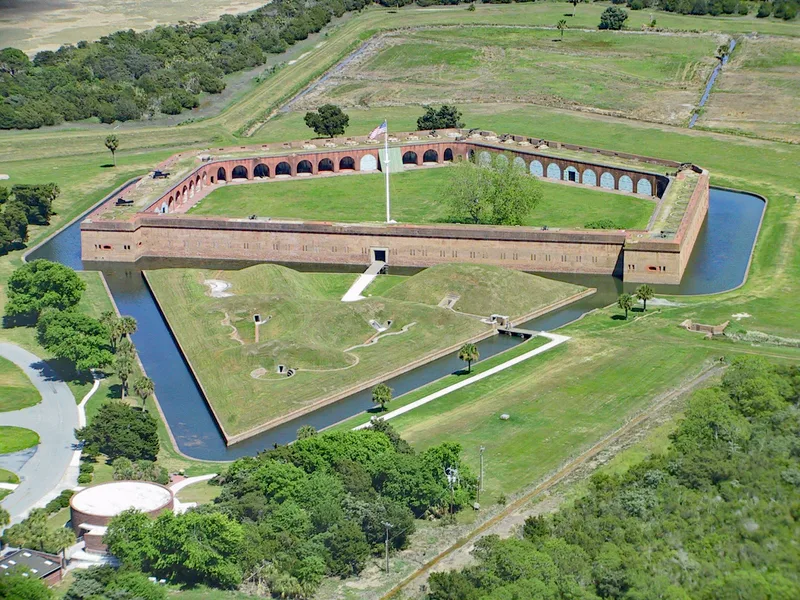
Fort Pulaski occupies Cockspur Island at the mouth of the Savannah River, where it was built between 1829 and 1847 to guard Savannah from attack by sea. The five-sided brick fort has walls 7½ feet thick, a triangular demilune and a wet moat, and it sits within a system of dikes and drainage ditches. It was one of a chain of coastal forts designed by French engineer Simon Bernard for the Army Corps of Engineers. In 1862 Federal rifled artillery reduced the fort quickly, a result that made masonry forts obsolete. Other resources on the island include brick cisterns and workmen's village foundations from the construction years, a granite pier of 1829-30, the Cockspur Island Lighthouse of about 1840, Battery Horace Hambright of about 1895, a quarantine station residence of about 1896, and a 1950 memorial to John Wesley's 1736 landing. Restoration in the 1930s left the fort in excellent condition, with siege damage still visible.
Significance in brief: The fort is described as the best preserved and most original of the eastern coastal forts designed by Simon Bernard for the Army Corps of Engineers. Its rapid reduction by rifled artillery in 1862 made masonry forts obsolete, which gives it major military significance. It is also noted for its engineering and the quality of its masonry and joinery.
Machine-generated summary. This summary was generated by a language model from the official nomination document and has not been reviewed line by line by an editor. It may contain errors. Check the source document before relying on any detail. Source: nomination document (PDF) · National Archives catalog entry. NRHP reference 66000064, listed October 15, 1966. Summary generated October 2026 (model claude-sonnet-5-5, prompt v1.0-2026-10-29, confidence medium).
Key facts
| Address | 17 mi. W of Savannah, Cockspur Island, Savannah |
|---|---|
| County | Chatham County |
| Listed | October 15, 1966 |
| Reference number | 66000064 |
| Resource type | District |
| Period of significance | 19th Century (construction 1829-47; garrisoned 1861-72; briefly 1890s) |
| Architect / builder | Simon Bernard (French military engineer, designer of the fort system, for the U.S. Army Corps of Engineers); Edward Jones, Architect of Albany, GA (John Wesley Memorial) |
| Areas of significance | Military, Engineering, Architecture |
| Level of significance | National |
| Status (as stated in the nomination) | Fort in excellent condition after extensive National Park Service restoration in the 1930s; exterior unaltered; interpreted to the public as a national monument. |
| Acreage | 260 |
| Coordinates | 32.02852, -80.89713 (NPS GIS) |
What listing means for this property
This is a historic district. Buildings within its boundary are either contributing (they add to the district's significance) or non-contributing. Owners of contributing income-producing buildings can claim the 20% federal rehabilitation tax credit; homeowners should look at state credits. National Register districts impose no design review by themselves; a local historic district ordinance, if one exists, does (the difference explained).
General information, not legal or tax advice. Rules change; confirm with your State Historic Preservation Office or a qualified adviser.
Sources and further reading
- National Park Service, National Register of Historic Places database (snapshot May 2026), reference 66000064.
- Nomination form (PDF, National Archives) — catalog entry
- Wikipedia article (used for cross-checking only; text not reproduced here)
- Wikidata Q1438683
- This listing as JSON
Last updated October 2026. Found an error? See the editorial policy for how to report it.