North Villa Rica Commercial Historic District
Also known as: Hixtown; Chevestown

Why it's listed
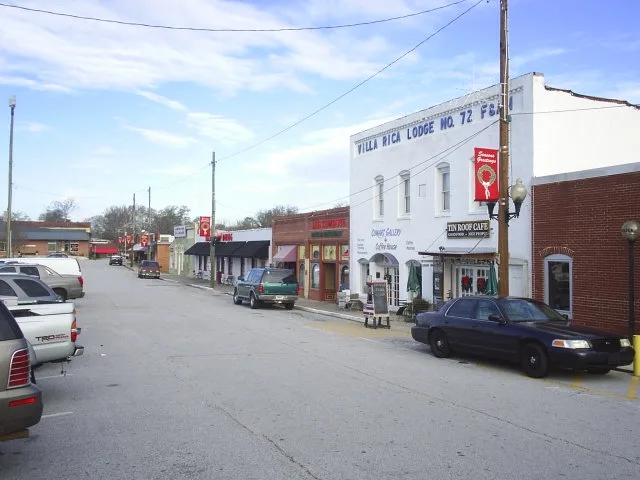
Downtown Villa Rica north of the railroad tracks forms a compact commercial district of mostly attached one-story brick buildings, built largely between 1900 and 1929. The town was laid out in 1883, a year after the Georgia Pacific Railroad arrived, on a gridiron plan centered on the rail line and a public square. Storefronts typically have center entrances, display windows and decorative brickwork along the parapet. Six brick cotton warehouses stand among the shops, reflecting a local economy that moved from gold mining to cotton; about 10,000 bales were sold in an average season. Hosiery mills and a cap company added manufacturing to the mix. A few buildings, including city hall, were altered too much to count as contributing. The district was listed for its commercial architecture, its role in the area's commerce and industry, and its example of a cross-rail town plan, with a significance period of 1882 to 1952.
Significance in brief: The district is significant for its early 20th-century commercial architecture, including retail buildings and commercial cotton warehouses. It also reflects Villa Rica's role as a commerce and industry center in eastern Carroll County. It is an example of a cross-rail town with a gridiron plan laid out in 1883 beside the railroad.
Machine-generated summary. This summary was generated by a language model from the official nomination document and has not been reviewed line by line by an editor. It may contain errors. Check the source document before relying on any detail. Source: nomination document (PDF) · National Archives catalog entry. NRHP reference 02001635, listed December 31, 2002. Summary generated October 2026 (model claude-sonnet-5-5, prompt v1.0-2026-10-29, confidence high).
Key facts
| Address | Roughly bounded by Southern Railroad, North Ave., and East Gordon and West Church Sts., Villa Rica |
|---|---|
| County | Carroll County |
| Listed | December 31, 2002 |
| Reference number | 02001635 |
| Resource type | District |
| Period of significance | 1882-1952 |
| Architect / builder | Cleghorn Brothers (builders) |
| Architectural style | Late 19th and Early 20th Century American Movements: Commercial Style |
| Criteria |
|
| Areas of significance | Architecture, Commerce, Industry, Community Planning and Development |
| Level of significance | Local |
| Status (as stated in the nomination) | Most buildings retain high historic integrity. One warehouse was recently rehabilitated as loft apartments, and a cap company still operates on the 200 block of Temple Street. The railroad depot was demolished after 1950. |
| Acreage | 9 |
| Coordinates | 33.73228, -84.92496 (NPS GIS) |
What listing means for this property
This is a historic district. Buildings within its boundary are either contributing (they add to the district's significance) or non-contributing. Owners of contributing income-producing buildings can claim the 20% federal rehabilitation tax credit; homeowners should look at state credits. National Register districts impose no design review by themselves; a local historic district ordinance, if one exists, does (the difference explained).
General information, not legal or tax advice. Rules change; confirm with your State Historic Preservation Office or a qualified adviser.
Sources and further reading
- National Park Service, National Register of Historic Places database (snapshot May 2026), reference 02001635.
- Nomination form (PDF, National Archives) — catalog entry
- Wikipedia article (used for cross-checking only; text not reproduced here)
- Wikidata Q7057127
- This listing as JSON
Last updated October 2026. Found an error? See the editorial policy for how to report it.