Metter Downtown Historic District

Why it's listed
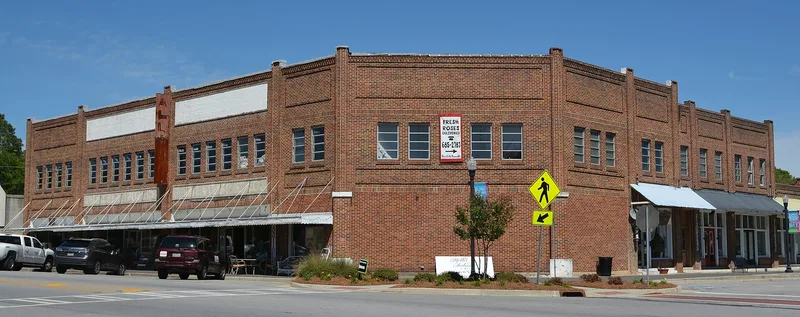
Metter's downtown is a compact commercial and civic center in rural southeast Georgia, planned in 1899 on a uniform grid and shaped by the Central of Georgia Railroad, which ran its first train through in 1901. The tracks once split Broad Street in two; after their removal around 1950, a city park and landscaped parking took their place. Most buildings are attached one- and two-story brick storefronts with flat roofs and plain detailing, with occasional Victorian and classical touches. Notable buildings include the 1904 marble-faced bank, the 1916 Masonic building, the c.1930 Allied Building, the 1930 Art Deco Dixie Theater, the 1921 Neo-Classical Revival courthouse designed by James J. Baldwin, and the 1902 depot, moved in the 1950s. A 1960 International Style post office and two Baptist churches complete the district. It is significant as the commercial and governmental heart of Candler County, formed in 1914, and as a largely intact example of an early twentieth-century railroad town.
Significance in brief: The district is nominated at the local level under Criteria A and C as a well-preserved downtown that served as the county seat and commercial center of Candler County. It reflects the town's planned grid layout, its growth after the railroad arrived in 1901, and its role in commerce and local government, including the 1921 courthouse.
Machine-generated summary. This summary was generated by a language model from the official nomination document and has not been reviewed line by line by an editor. It may contain errors. Check the source document before relying on any detail. Source: nomination document (PDF) · National Archives catalog entry. NRHP reference 11000578, listed August 24, 2011. Summary generated October 2026 (model claude-sonnet-5-5, prompt v1.0-2026-10-29, confidence medium).
Key facts
| Address | Centered on Broad & Roundtree Sts., Metter |
|---|---|
| County | Candler County |
| Listed | August 24, 2011 |
| Reference number | 11000578 |
| Resource type | District |
| Period of significance | c.1899-1961 |
| Architect / builder | Baldwin, James J. (architect of the 1921 Candler County Courthouse) |
| Architectural style | Late Victorian: Italianate; Late 19th and 20th Century Revivals: Classical Revival, Italian Renaissance; Commercial Style; Modern Movement: International Style, Art Deco |
| Criteria |
|
| Areas of significance | Architecture, Commerce, Community Planning and Development, Politics/Government |
| Level of significance | Local |
| Status (as stated in the nomination) | Most downtown buildings remain in commercial, government and religious use; the district retains good historic integrity, with fewer than one-fourth of buildings noncontributing. The 1902 depot was rehabilitated in the 1990s for city meetings and events. |
| Acreage | 22 |
| Coordinates | 32.39670, -82.06061 (NPS GIS) |
What listing means for this property
This is a historic district. Buildings within its boundary are either contributing (they add to the district's significance) or non-contributing. Owners of contributing income-producing buildings can claim the 20% federal rehabilitation tax credit; homeowners should look at state credits. National Register districts impose no design review by themselves; a local historic district ordinance, if one exists, does (the difference explained).
General information, not legal or tax advice. Rules change; confirm with your State Historic Preservation Office or a qualified adviser.
Sources and further reading
- National Park Service, National Register of Historic Places database (snapshot May 2026), reference 11000578.
- Nomination form (PDF, National Archives) — catalog entry
- Wikipedia article (used for cross-checking only; text not reproduced here)
- Wikidata Q30621973
- This listing as JSON
Last updated October 2026. Found an error? See the editorial policy for how to report it.