Edison Commercial Historic District

Approximate location: the National Park Service places this pin arbitrarily within the property, not at a surveyed point (stated accuracy ±12 m).
Why it's listed
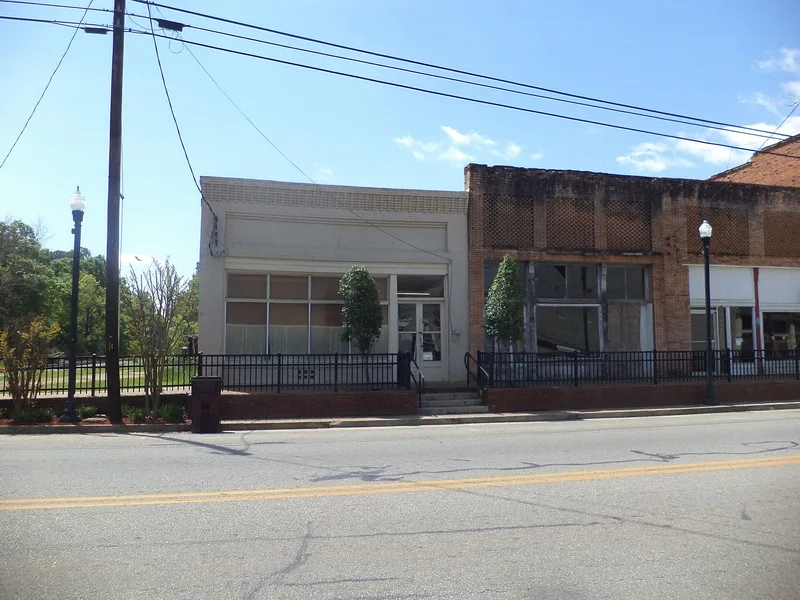
Edison's commercial core in southwest Georgia grew around the crossing of two early trade routes, the Hartford Trail and the Cuthbert-Bainbridge Road. When the Georgia, Florida, and Alabama Railroad arrived in 1902, the town incorporated and quickly filled with banks, hotels, a department store, cotton warehouses and gins. The surviving district holds 22 contributing buildings and the railroad right-of-way, mostly one- and two-story brick storefronts sharing party walls. Details include corbeled cornices, cast-iron columns, transoms and original storefronts, often in a Folk Victorian manner. A 1951 theater, built on a lot long used for community events and traveling shows, closes the period of significance. The area is recognized for its architecture, for its role as the trade, banking and newspaper center of Calhoun County even though it is not the county seat, and as a clear example of a crossroads town with a railroad.
Significance in brief: The district is significant in architecture for its intact one- and two-story brick commercial buildings typical of small Georgia towns, many with Folk Victorian detailing. It is significant in commerce as the banking, trade and communications center of Calhoun County, and in community planning as a good example of a crossroads town with a railroad.
Machine-generated summary. This summary was generated by a language model from the official nomination document and has not been reviewed line by line by an editor. It may contain errors. Check the source document before relying on any detail. Source: nomination document (PDF) · National Archives catalog entry. NRHP reference 00000528, listed May 26, 2000. Summary generated October 2026 (model claude-sonnet-5-5, prompt v1.0-2026-10-29, confidence medium).
Key facts
| Address | Hartford St./GA 37 and Turner St./GA216, Edison |
|---|---|
| County | Calhoun County |
| Listed | May 26, 2000 |
| Reference number | 00000528 |
| Resource type | District |
| Period of significance | 1902-1951 |
| Architectural style | Folk Victorian |
| Criteria |
|
| Areas of significance | Architecture, Commerce, Community Planning and Development |
| Level of significance | Local |
| Status (as stated in the nomination) | Commercial and city hall uses continue. The former Hammack-Rish Bank building still stands but has not been a bank for many years, and the former newspaper office is planned for rehabilitation as a museum. |
| Acreage | 5 |
| Coordinates | 31.55788, -84.74052 (NPS GIS) |
What listing means for this property
This is a historic district. Buildings within its boundary are either contributing (they add to the district's significance) or non-contributing. Owners of contributing income-producing buildings can claim the 20% federal rehabilitation tax credit; homeowners should look at state credits. National Register districts impose no design review by themselves; a local historic district ordinance, if one exists, does (the difference explained).
General information, not legal or tax advice. Rules change; confirm with your State Historic Preservation Office or a qualified adviser.
Sources and further reading
- National Park Service, National Register of Historic Places database (snapshot May 2026), reference 00000528.
- Nomination form (PDF, National Archives) — catalog entry
- Wikipedia article (used for cross-checking only; text not reproduced here)
- Wikidata Q29094962
- This listing as JSON
Last updated October 2026. Found an error? See the editorial policy for how to report it.