McCanaan Missionary Baptist Church and Cemetery
Also known as: First McCanaan Baptist Church

Why it's listed
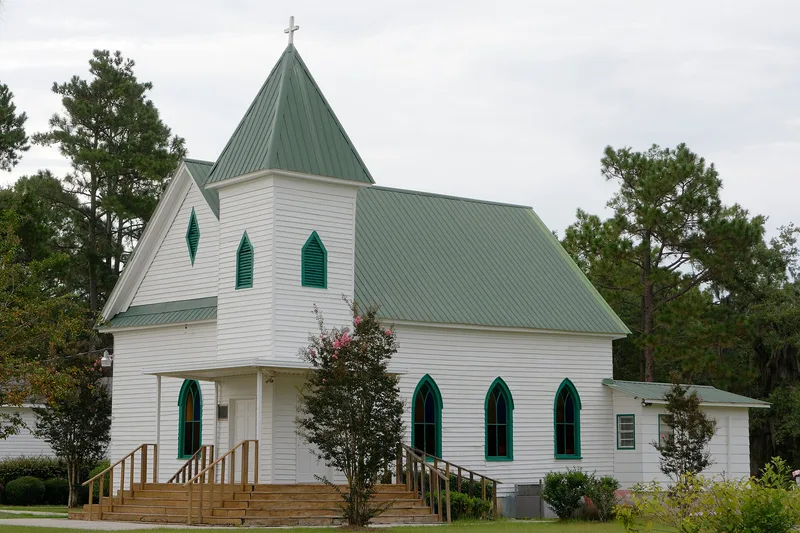
McCanaan Missionary Baptist Church and Cemetery sits on about two acres in rural Burke County, Georgia, near Sardis. The congregation was organized in 1875 by Rev. Frank Cooper, who went on to found five churches and the Frank Cooper Missionary Baptist Association. Its first building burned in the early 1890s, a prayer house followed, and the present church was built in 1912 from locally cut timber. The one-story, wood-framed building has weatherboard siding, a metal roof, a conical-roofed side tower, lancet windows and a diamond-patterned wooden ceiling inside. Many members were sharecroppers at nearby Millhaven Plantation. A school for grades one through six once stood behind the church but was demolished in the 1930s. After a flood cut access to the earlier burial ground at Millhaven, burials moved to the church grounds in the early 1930s. The property was listed for its architecture and for its role as a rural African-American institution.
Significance in brief: The nomination argues the church is an excellent example of a rural African-American church with a cemetery, with a single side tower and simple Gothic Revival detailing. It is also significant for ethnic heritage as an institution that gave sharecropping families religious, educational and social autonomy in rural Georgia.
Machine-generated summary. This summary was generated by a language model from the official nomination document and has not been reviewed line by line by an editor. It may contain errors. Check the source document before relying on any detail. Source: nomination document (PDF) · National Archives catalog entry. NRHP reference 01000643, listed June 14, 2001. Summary generated October 2026 (model claude-sonnet-5-5, prompt v1.0-2026-10-29, confidence high).
Key facts
| Address | McCanaan Church Rd., Sardis |
|---|---|
| County | Burke County |
| Listed | June 14, 2001 |
| Reference number | 01000643 |
| Resource type | Building |
| Period of significance | 1912 - 1951 |
| Architectural style | OTHER: rural vernacular church (side-steeple type with Gothic Revival features) |
| Criteria |
|
| Areas of significance | Architecture, Black |
| Level of significance | Local |
| Status (as stated in the nomination) | Church and cemetery remain in religious and funerary use; a noncontributing modern auxiliary building stands beside the church. |
| Acreage | 2 |
| Coordinates | 32.98444, -81.70218 (NPS GIS) |
What listing means for this property
Religious properties are listed for their architectural or historical significance, not their religious use. Listing is honorary and does not restrict the congregation's use of the building. The federal rehabilitation credit is generally unavailable unless part of the building is income-producing; some state programmes and preservation grants do cover religious buildings. Federal funding or permits trigger Section 106 review.
General information, not legal or tax advice. Rules change; confirm with your State Historic Preservation Office or a qualified adviser.
Sources and further reading
- National Park Service, National Register of Historic Places database (snapshot May 2026), reference 01000643.
- Nomination form (PDF, National Archives) — catalog entry
- Wikipedia article (used for cross-checking only; text not reproduced here)
- Wikidata Q16894878
- This listing as JSON
Last updated October 2026. Found an error? See the editorial policy for how to report it.