Hopeful Baptist Church

Why it's listed
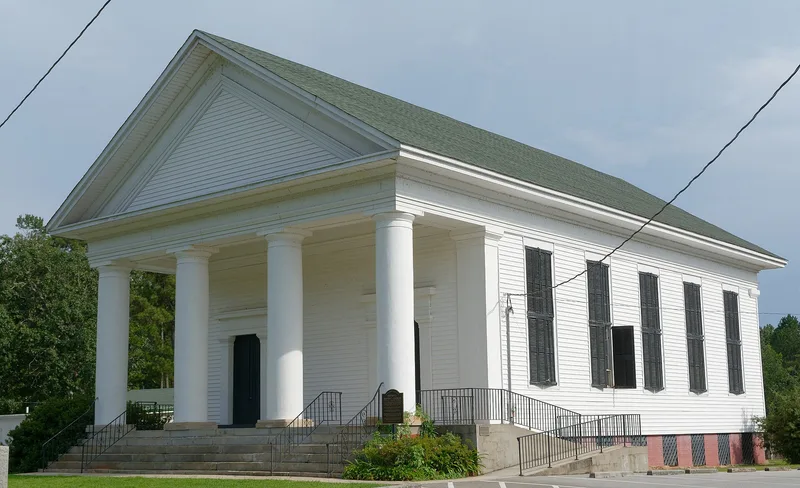
Hopeful Baptist Church is a rural Greek Revival church on Winter Road near Keysville in Burke County, Georgia. Built between 1850 and 1851 of local heart pine, it is a one-story frame building on hand-made brick piers, with a gabled temple front, four round masonry columns, pilasters, an entablature and long Stone Mountain granite steps. Inside, the original handcrafted pews, high pulpit, hardware and windows survive. The congregation dates to 1815, and this is its fourth meeting house. Before the Civil War, white members and enslaved Black members worshiped together here, and the rear pews were set aside for the enslaved. Black members were allowed their own preacher once a month from 1855 and left in 1867 to found Second Hopeful Baptist. The property also includes a historic cemetery and later outbuildings. It was recognized for its architecture and for its record of a biracial antebellum congregation.
Significance in brief: The nomination argues the church is a nearly classic rural example of Greek Revival temple-form architecture that retains its original pews, pulpit, hardware, windows and moldings. It is also significant for Black history and religion, because it documents an antebellum congregation of white and enslaved Black members who worshiped together, with a section of pews set aside for slaves, until the Black members left in 1867 to form Second Hopeful Baptist.
Machine-generated summary. This summary was generated by a language model from the official nomination document and has not been reviewed line by line by an editor. It may contain errors. Check the source document before relying on any detail. Source: nomination document (PDF) · National Archives catalog entry. NRHP reference 92001734, listed January 11, 1993. Summary generated October 2026 (model claude-sonnet-5-5, prompt v1.0-2026-10-29, confidence high).
Key facts
| Address | Winter Rd. E of jct. with Blythe Rd., Keysville |
|---|---|
| County | Burke County |
| Listed | January 11, 1993 |
| Reference number | 92001734 |
| Resource type | Building |
| Period of significance | ca. 1850-1942 |
| Architect / builder | Unknown |
| Architectural style | Greek Revival |
| Criteria |
|
| Areas of significance | Black, Architecture, Religion |
| Level of significance | State |
| Status (as stated in the nomination) | Active congregation; church and grounds described as well maintained, with no major restoration or alteration since 1851 apart from vinyl siding, electricity and heating added in the twentieth century. |
| Acreage | 9.3 |
| Coordinates | 33.20968, -82.13402 (NPS GIS) |
What listing means for this property
Religious properties are listed for their architectural or historical significance, not their religious use. Listing is honorary and does not restrict the congregation's use of the building. The federal rehabilitation credit is generally unavailable unless part of the building is income-producing; some state programmes and preservation grants do cover religious buildings. Federal funding or permits trigger Section 106 review.
General information, not legal or tax advice. Rules change; confirm with your State Historic Preservation Office or a qualified adviser.
Sources and further reading
- National Park Service, National Register of Historic Places database (snapshot May 2026), reference 92001734.
- Nomination form (PDF, National Archives) — catalog entry
- Wikipedia article (used for cross-checking only; text not reproduced here)
- Wikidata Q16892420
- This listing as JSON
Last updated October 2026. Found an error? See the editorial policy for how to report it.