Olliff, William W., Farm

Why it's listed
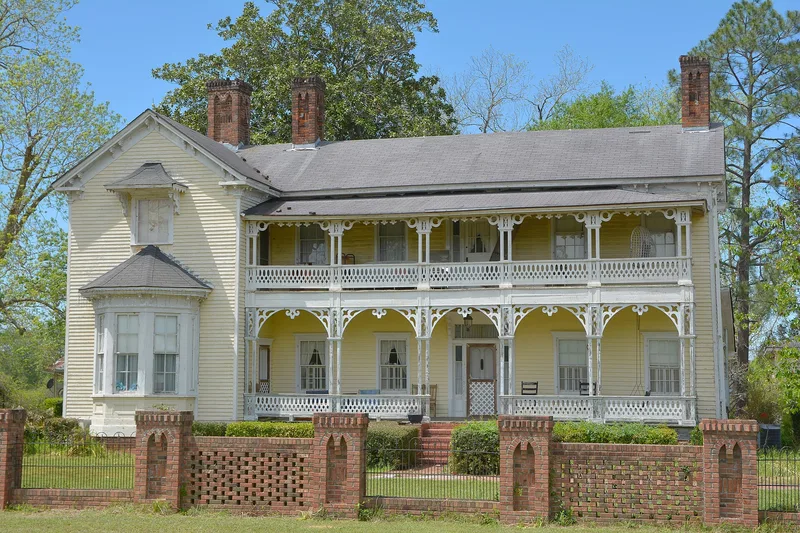
This farm in rural Bulloch County, Georgia, centers on a twelve-room, two-story farmhouse completed in 1872 for merchant and landowner William W. Olliff. The wood-frame house has an L-shaped plan, original heart pine weatherboards, a bay window, and a two-story porch with sawn ornamentation and paired brackets. Inside are a walnut staircase, ornate mantels, wainscoting, and original doors with cast-iron lock boxes. Master carpenter Edward Ringwald, a German immigrant, built it, using mostly local materials. Surviving outbuildings include a cotton house, dairy shed, barn, smokehouse, wood shed, boiler shed, hog gallows and cane mill, set among pecan trees. The property was listed for its architecture and for Olliff's role in local life. He ran the area's largest general store, was among the first to sell fertilizer in the county, helped build its first two railroads, and was believed to be its largest landowner. The period of significance runs from 1872 to his death in 1893.
Significance in brief: The house is argued to be an exceptional example of Victorian vernacular architecture with Italianate detailing in a county of mostly small weatherboard houses. The unusually large group of surviving outbuildings documents farm building types and methods in south Georgia. The farm is also tied to merchant and landowner William W. Olliff, who sold the area's first commercial fertilizer and helped build the county's first two railroads.
Machine-generated summary. This summary was generated by a language model from the official nomination document and has not been reviewed line by line by an editor. It may contain errors. Check the source document before relying on any detail. Source: nomination document (PDF) · National Archives catalog entry. NRHP reference 87002113, listed December 4, 1987. Summary generated October 2026 (model claude-sonnet-5-5, prompt v1.0-2026-10-29, confidence high).
Key facts
| Address | New Hope Rd., Register |
|---|---|
| County | Bulloch County |
| Listed | December 4, 1987 |
| Reference number | 87002113 |
| Resource type | Building |
| Period of significance | 1872-1893 |
| Architect / builder | Builder: Edward Ringwald; William W. "Bill" Olliff (listed as significant person) |
| Architectural style | Late Victorian/Italianate |
| Criteria |
|
| Areas of significance | Agriculture, Commerce, Transportation, Architecture |
| Level of significance | Local |
| Status (as stated in the nomination) | Farmhouse and several outbuildings are in use; the barn, storage shed and cotton house are described as in poor condition. |
| Acreage | 12 |
| Coordinates | 32.29050, -81.94294 (NPS GIS) |
What listing means for this property
National Register listing is honorary for a privately owned home: it does not by itself restrict what an owner may do with their own money, and it does not require public access. Restrictions come from local landmark or historic-district ordinances, which are separate (how they differ).
Owner-occupied houses are not eligible for the 20% federal rehabilitation tax credit, which applies to income-producing buildings, but many states offer credits for homeowners. Listing also opens the door to preservation easements and to buying a plaque. Start with what listing means for homeowners, renovating a listed house and selling one.
General information, not legal or tax advice. Rules change; confirm with your State Historic Preservation Office or a qualified adviser.
Sources and further reading
- National Park Service, National Register of Historic Places database (snapshot May 2026), reference 87002113.
- Nomination form (PDF, National Archives) — catalog entry
- Wikidata Q134133597
- This listing as JSON
Last updated October 2026. Found an error? See the editorial policy for how to report it.