Bryan Neck Presbyterian Church

Why it's listed
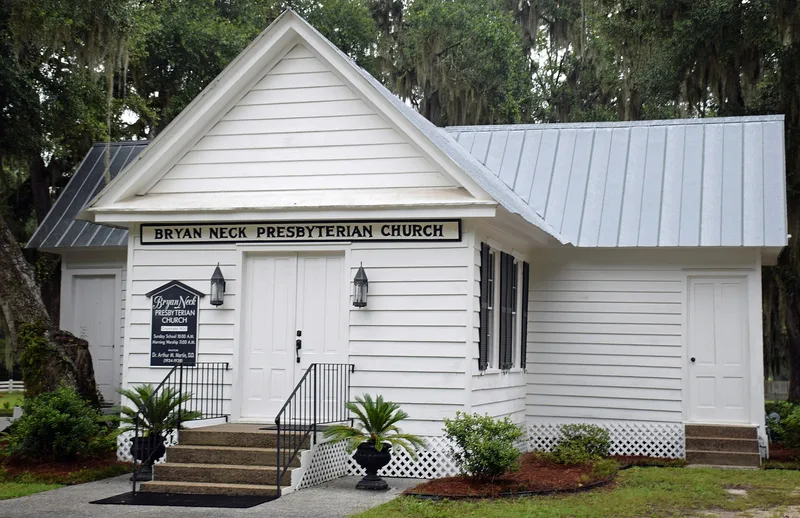
Set on a level, sandy two-acre lot shaded by live oak, pine and palm trees in Keller, Georgia, this small rural Presbyterian complex includes a church, a manse and a cemetery in a row along Belfast Keller Road. The one-story, cruciform-plan church was completed in 1885 as the congregation's third building, after its earlier church burned in 1882. Its weatherboard exterior is plain, but the interior is covered in dark varnished paneling laid vertically, horizontally and diagonally, with a diamond pattern in the apse and chamfered scissor-brace roof trusses. Pews, lectern and organ are largely original. The Colonial Revival manse was built in 1939 when Henry Ford, who needed church-owned land for his nearby operations, had it constructed in exchange. The cemetery dates from about 1900 and holds over 200 burials. Few rural Georgia churches have escaped siding, replacement windows, porticos and additions as this one has.
Significance in brief: The church is argued to be an outstanding example of a plain rural church with elaborate Craftsman-style interior woodwork. Its cruciform plan is unusual for such a small building in Georgia, and it has kept an unusually high level of historic integrity. The 1939 manse and the cemetery add a picture of the continued use and land use of a rural church site.
Machine-generated summary. This summary was generated by a language model from the official nomination document and has not been reviewed line by line by an editor. It may contain errors. Check the source document before relying on any detail. Source: nomination document (PDF) · National Archives catalog entry. NRHP reference 00000193, listed March 15, 2000. Summary generated October 2026 (model claude-sonnet-5-5, prompt v1.0-2026-10-29, confidence high).
Key facts
| Address | Belfast Keller Rd., Keller |
|---|---|
| County | Bryan County |
| Listed | March 15, 2000 |
| Reference number | 00000193 |
| Resource type | Building |
| Period of significance | 1885 - 1939 |
| Architectural style | Late 19th and Early 20th Century American Movements: Craftsman; Late 19th and Early 20th Century Revivals: Colonial Revival |
| Criteria |
|
| Areas of significance | Architecture |
| Level of significance | Local |
| Status (as stated in the nomination) | The church has been in continuous use since 1885. After the congregation merged with Richmond Hill Presbyterian Church in the 1990s, it is used for special functions and religious services. The cemetery remains active, with burials only in existing family plots. |
| Acreage | 2 |
| Coordinates | 31.84180, -81.26087 (NPS GIS) |
What listing means for this property
Religious properties are listed for their architectural or historical significance, not their religious use. Listing is honorary and does not restrict the congregation's use of the building. The federal rehabilitation credit is generally unavailable unless part of the building is income-producing; some state programmes and preservation grants do cover religious buildings. Federal funding or permits trigger Section 106 review.
General information, not legal or tax advice. Rules change; confirm with your State Historic Preservation Office or a qualified adviser.
Sources and further reading
- National Park Service, National Register of Historic Places database (snapshot May 2026), reference 00000193.
- Nomination form (PDF, National Archives) — catalog entry
- Wikipedia article (used for cross-checking only; text not reproduced here)
- Wikidata Q14686602
- This listing as JSON
Last updated October 2026. Found an error? See the editorial policy for how to report it.