Auburn Historic District

Why it's listed
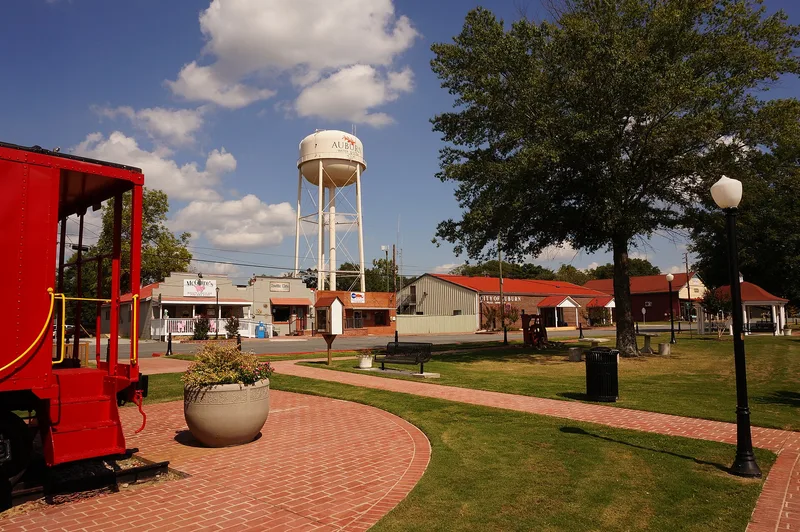
Auburn's historic core is a railroad town in Barrow County, Georgia, laid out around an east-west rail line after the Seaboard Railroad arrived in 1891. The district covers a small commercial strip, late 19th and early 20th century neighborhoods, and the town cemetery at its edge. Its 24 contributing resources include modest frame houses such as Georgian-type, gabled-ell, Queen Anne-type and I-house cottages, Craftsman bungalows, and two railroad section houses. Brick and stone stores recall the town's boom years. The railroad brought incorporation in 1892, a grid plan, warehouses and a switching track, and it supported the Perry-Rainey Institute, a Baptist school that drew students from across the state until it closed in 1924. The depot, warehouses and school buildings have been lost, but the street pattern and the working rail line survive. The district represents typical small-town Georgia architecture and railroad-driven town planning between about 1891 and 1947.
Significance in brief: The district is significant for architecture, community planning and development, and transportation. Its houses and commercial buildings are typical small-town Georgia types of the 1890s to 1920s. The 1891 arrival of the railroad created the town's grid plan around the tracks and brought a new community to a farming area.
Machine-generated summary. This summary was generated by a language model from the official nomination document and has not been reviewed line by line by an editor. It may contain errors. Check the source document before relying on any detail. Source: nomination document (PDF) · National Archives catalog entry. NRHP reference 97000527, listed June 4, 1997. Summary generated October 2026 (model claude-sonnet-5-5, prompt v1.0-2026-10-29, confidence high).
Key facts
| Address | Roughly bounded by 3rd Ave., 6th St., 6th Ave., and Main St., Auburn |
|---|---|
| County | Barrow County |
| Listed | June 4, 1997 |
| Reference number | 97000527 |
| Resource type | District |
| Period of significance | ca. 1891-1947 |
| Architect / builder | Unknown |
| Architectural style | Late 19th and early 20th century American movements (bungalow/Craftsman); Late Victorian (Queen Anne type cottages); Folk Victorian; Georgian-type, gabled-ell, I-house and central hall-type cottages |
| Criteria |
|
| Areas of significance | Architecture, Community Planning and Development, Transportation |
| Level of significance | Local |
| Status (as stated in the nomination) | Some historic buildings are in current use as a city hall annex, library, restaurants, shops and homes. The railroad is still in use. The depot, railroad warehouses and the Perry-Rainey Institute administration building are gone. |
| Acreage | 20 |
| Coordinates | 34.01300, -83.82712 (NPS GIS) |
What listing means for this property
This is a historic district. Buildings within its boundary are either contributing (they add to the district's significance) or non-contributing. Owners of contributing income-producing buildings can claim the 20% federal rehabilitation tax credit; homeowners should look at state credits. National Register districts impose no design review by themselves; a local historic district ordinance, if one exists, does (the difference explained).
General information, not legal or tax advice. Rules change; confirm with your State Historic Preservation Office or a qualified adviser.
Sources and further reading
- National Park Service, National Register of Historic Places database (snapshot May 2026), reference 97000527.
- Nomination form (PDF, National Archives) — catalog entry
- Wikidata Q141700616
- This listing as JSON
Last updated October 2026. Found an error? See the editorial policy for how to report it.