Zion Evangelical Lutheran Church Cemetery

The National Park Service has not published a boundary polygon for this district; the map shows the listed properties inside it and the district's reference point.
Why it's listed
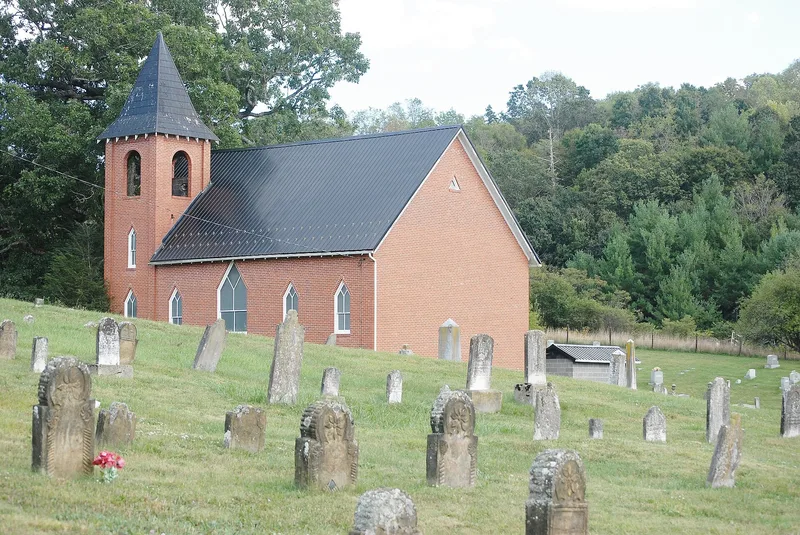
Zion Evangelical Lutheran Church Cemetery occupies about three acres on a steep hillside among farmlands near Speedwell, in southwestern Wythe County. Of its 250 to 300 markers, 42 are thick sandstone gravestones carved on both sides in a Germanic tradition. Although their dates range from the 1790s to 1840, inscriptions show they were all carved around 1835 to 1840, probably by a skilled carver who arrived in the mid-1830s. Typical stones have rounded tops decorated with six- or eight-petaled flowers, scrolls, spiral pilasters and pinwheels, while the footstones take more fanciful shapes. The congregation was formed in 1791, and John Stanger gave land for the first church in 1794. The present brick church dates from 1940. The stones are well preserved and recall the heavy German settlement of the area in the late 18th century. They also show that European craft traditions lasted there longer than elsewhere in Virginia.
Machine-generated summary. This summary was generated by a language model from the official nomination document and has not been reviewed line by line by an editor. It may contain errors. Check the source document before relying on any detail. Source: nomination document (PDF) · catalog entry. Generated October 2026 (model claude-sonnet-5-5, prompt v1.0-2026-10-29).
| Period of significance | ca. 1835-1840 |
|---|---|
| Areas of significance | Art, European, Exploration/Settlement, Religion |
| Acreage | 3 |
| Boundary source | not published |
| Full listing page | Zion Evangelical Lutheran Church Cemetery (property record) |
What listing means for this property
This is a historic district. Buildings within its boundary are either contributing (they add to the district's significance) or non-contributing. Owners of contributing income-producing buildings can claim the 20% federal rehabilitation tax credit; homeowners should look at state credits. National Register districts impose no design review by themselves; a local historic district ordinance, if one exists, does (the difference explained).
General information, not legal or tax advice. Rules change; confirm with your State Historic Preservation Office or a qualified adviser.