Woolen Mills Village Historic District

The National Park Service has not published a boundary polygon for this district; the map shows the listed properties inside it and the district's reference point.
Why it's listed
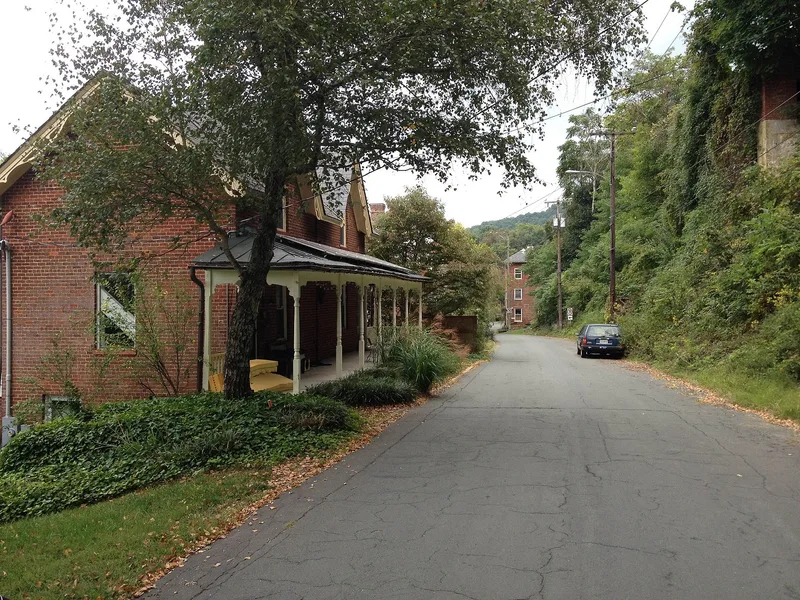
Woolen Mills Village is a former company town at the eastern end of East Market Street in Charlottesville, where Moore's Creek meets the Rivanna River. Milling began on the site in 1829, and the Charlottesville Woolen Mills was incorporated in 1868, later becoming a major producer of cloth for uniforms. The company built housing for its workers, including three brick Gothic Revival duplexes from the 1840s and the Pireus Row houses of the 1870s. A large frame house on the hill served the mill superintendent and later president, Henry Clay Marchant. In the 1880s nearby farmland was subdivided, and mill employees bought lots and built their own houses, mostly vernacular designs with Victorian or Colonial Revival porch details. Riverview Cemetery was founded in the 1890s. The mills closed in 1962, and the village was annexed by the city in 1968. Today it is mainly residential, and the surviving brick mill buildings recall its industrial past.
Machine-generated summary. This summary was generated by a language model from the official nomination document and has not been reviewed line by line by an editor. It may contain errors. Check the source document before relying on any detail. Source: nomination document (PDF) · catalog entry. Generated October 2026 (model claude-sonnet-5-5, prompt v1.0-2026-10-29).
| Period of significance | 1847-1962 |
|---|---|
| Styles | Mid-19th Century: Gothic Revival; Late Victorian; Colonial Revival; Bungalow/Craftsman; No Style |
| Areas of significance | Architecture, Industry, Social History |
| Acreage | 80.4 |
| Boundary source | not published |
| Full listing page | Woolen Mills Village Historic District (property record) |
What listing means for this property
This is a historic district. Buildings within its boundary are either contributing (they add to the district's significance) or non-contributing. Owners of contributing income-producing buildings can claim the 20% federal rehabilitation tax credit; homeowners should look at state credits. National Register districts impose no design review by themselves; a local historic district ordinance, if one exists, does (the difference explained).
General information, not legal or tax advice. Rules change; confirm with your State Historic Preservation Office or a qualified adviser.