West Fork Furnace

The National Park Service has not published a boundary polygon for this district; the map shows the listed properties inside it and the district's reference point.
Why it's listed
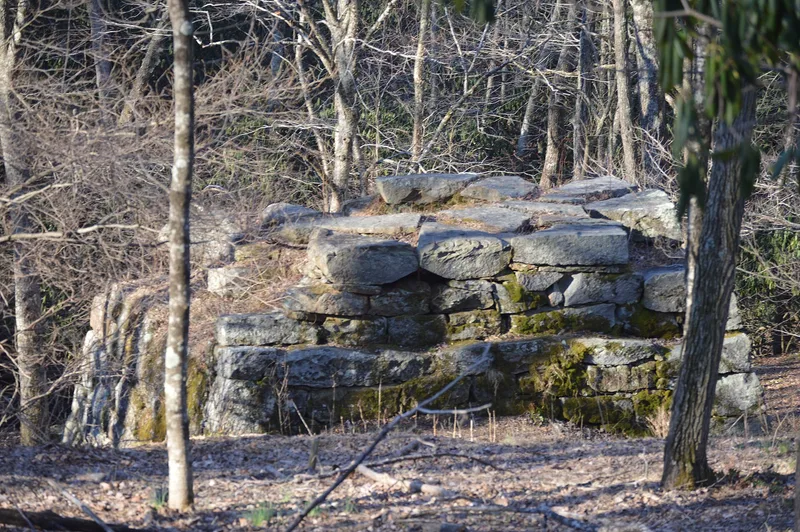
Deep in a forested valley southeast of the Town of Floyd, a massive stone furnace stack marks the site of an iron works built around 1853. The 2.6-acre property keeps the furnace, a dry-laid retaining wall, a ridge-top staging area where charcoal, ore and limestone were stored, a head race, a wheel pit and a tail race. Water from the East Prong of Furnace Creek powered a waterwheel that drove the bellows. Robert Toncray raised the venture, but costs of hauling limestone, poor markets for the copper-bearing iron and financial troubles ended production by late 1855. The furnace never fired again and stayed largely unchanged for about 140 years. That short life left an unusually intact mid-19th-century industrial site. It was listed for its engineering value as a distinctive ore-processing system and for the archaeological deposits in the staging area that may reveal how such furnaces were designed and operated. A Shelor family organization bought the property in 1990.
Machine-generated summary. This summary was generated by a language model from the official nomination document and has not been reviewed line by line by an editor. It may contain errors. Check the source document before relying on any detail. Source: nomination document (PDF) · catalog entry. Generated October 2026 (model claude-sonnet-5-5, prompt v1.0-2026-10-29).
| Period of significance | 1853-1855 |
|---|---|
| Styles | No Style |
| Areas of significance | Engineering, Historic - Non-Aboriginal |
| Acreage | 2.6 |
| Boundary source | not published |
| Full listing page | West Fork Furnace (property record) |
What listing means for this property
This is a historic district. Buildings within its boundary are either contributing (they add to the district's significance) or non-contributing. Owners of contributing income-producing buildings can claim the 20% federal rehabilitation tax credit; homeowners should look at state credits. National Register districts impose no design review by themselves; a local historic district ordinance, if one exists, does (the difference explained).
General information, not legal or tax advice. Rules change; confirm with your State Historic Preservation Office or a qualified adviser.