Wertland Street Historic District

Why it's listed
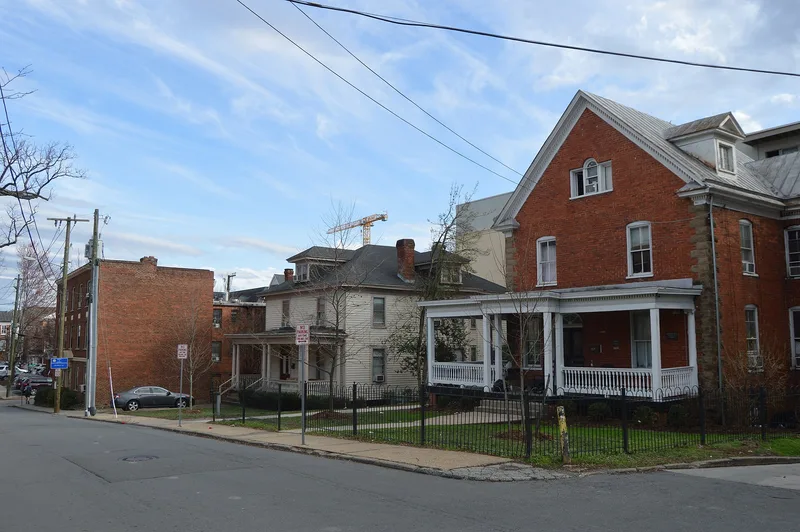
Wertland Street is a residential row just north of the University of Virginia in Charlottesville. Its roughly thirty buildings run between Tenth and Fourteenth Streets and form a cohesive streetscape of Victorian vernacular houses, with a few Federal, Queen Anne, Colonial Revival and Georgian Revival examples. The oldest is the brick Wertenbaker House of about 1830, built by William Wertenbaker, the University's second librarian, for whose family the street is named. Another early survivor, the McKennie-Miller House, was tied to the publisher of the city's first newspaper. Development as a fashionable neighborhood followed the subdivision of four large tracts in the 1880s, and more than fifteen houses stood by 1910. Large lots and standard setbacks on the north side create an orderly arrangement found nowhere else near the University. The district has changed little in about seventy years, and after decades of conversion to student apartments, many houses are being rehabilitated.
Machine-generated summary. This summary was generated by a language model from the official nomination document and has not been reviewed line by line by an editor. It may contain errors. Check the source document before relying on any detail. Source: nomination document (PDF) · catalog entry. Generated October 2026 (model claude-sonnet-5-5, prompt v1.0-2026-10-29).
| Period of significance | 1800-1899 and 1900- |
|---|---|
| Styles | Victorian Vernacular, with Federal, Queen Anne, Colonial Revival and Georgian Revival examples |
| Areas of significance | Commerce, Architecture |
| Acreage | 47 |
| Boundary source | NPS cultural-resource GIS polygon |
| Full listing page | Wertland Street Historic District (property record) |
What listing means for this property
This is a historic district. Buildings within its boundary are either contributing (they add to the district's significance) or non-contributing. Owners of contributing income-producing buildings can claim the 20% federal rehabilitation tax credit; homeowners should look at state credits. National Register districts impose no design review by themselves; a local historic district ordinance, if one exists, does (the difference explained).
General information, not legal or tax advice. Rules change; confirm with your State Historic Preservation Office or a qualified adviser.