Washington and Lee University Historic District

Why it's listed
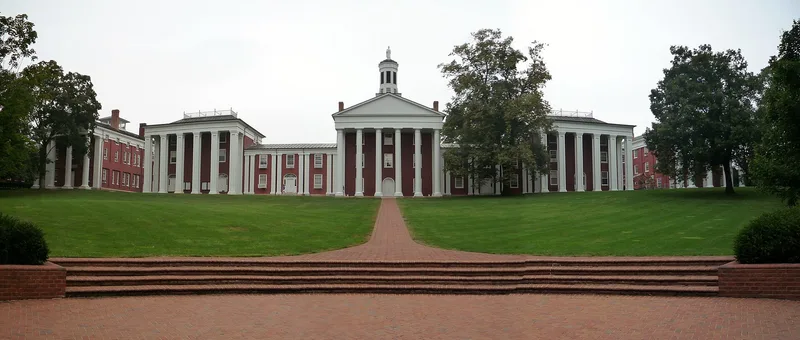
Washington and Lee University's historic core occupies a ridge along the western edge of Lexington, Virginia. Its centerpiece is the Colonnade, a row of brick buildings fronted with columns, piers and pilasters. Washington Hall, raised in 1824 to designs by John Jordan, anchors the group with a Roman Doric portico, and its cupola, topped by a wooden statue of George Washington carved by Matthew Kahle, was added in 1844. Payne and Robinson Halls, later Newcomb and Tucker Halls, and four faculty houses completed in 1843 extend the classical composition. Down the hill stands Lee Chapel, built in 1868 under Robert E. Lee's direction, where he was buried in 1870, and nearby is the President's House of 1869, first occupied by Lee. The district matters because these buildings, added over nearly 150 years, still read as one unified campus. Later Georgian Revival buildings nearby are placed discreetly. The Colonnade's interiors were replaced in a 1936 renovation, though the exteriors keep their early character.
Machine-generated summary. This summary was generated by a language model from the official nomination document and has not been reviewed line by line by an editor. It may contain errors. Check the source document before relying on any detail. Source: nomination document (PDF) · catalog entry. Generated October 2026 (model claude-sonnet-5-5, prompt v1.0-2026-10-29).
| Period of significance | 19th and 20th centuries (no specific dates stated) |
|---|---|
| Styles | Greek Revival / Roman Doric classicism (Colonnade); simplified Romanesque elements (Lee Chapel) |
| Areas of significance | Education, Architecture |
| Boundary source | NPS cultural-resource GIS polygon |
| Full listing page | Washington and Lee University Historic District (property record) |
What listing means for this property
This is a historic district. Buildings within its boundary are either contributing (they add to the district's significance) or non-contributing. Owners of contributing income-producing buildings can claim the 20% federal rehabilitation tax credit; homeowners should look at state credits. National Register districts impose no design review by themselves; a local historic district ordinance, if one exists, does (the difference explained).
General information, not legal or tax advice. Rules change; confirm with your State Historic Preservation Office or a qualified adviser.