Temple Hall

Why it's listed
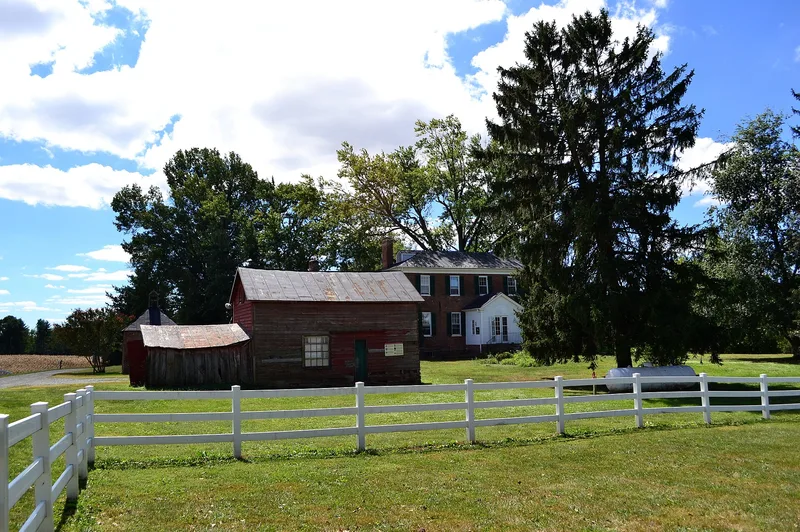
Temple Hall is a 286-acre farm in the rolling foothills of the Catoctin Mountains in northeastern Loudoun County, Virginia. Its centerpiece is a five-bay, 2½-story Federal-style brick house built around 1810 by William Temple Thomson Mason, set on a small bluff at the end of a tree-lined drive. The house has Flemish bond brickwork, a hipped metal roof, a paneled double door with pilasters and a fanlight, and a 1½-story brick wing to the east. A 1940s renovation by the Symington family added the pedimented portico and steel tie rods to stabilize the building. Nearby stand a brick smokehouse, a converted icehouse, a 19th-century barn and other farm buildings, with open fields around them. The property is significant for architecture and for agriculture. The farm kept working until 1985 and was a leader in crop trends, and the district boundary reflects the farm as it existed from about 1810 through 1956. The property is now a regional park.
Machine-generated summary. This summary was generated by a language model from the official nomination document and has not been reviewed line by line by an editor. It may contain errors. Check the source document before relying on any detail. Source: nomination document (PDF) · catalog entry. Generated October 2026 (model claude-sonnet-5-5, prompt v1.0-2026-10-29).
| Period of significance | circa 1810-1956 |
|---|---|
| Styles | Federal |
| Areas of significance | Architecture, Agriculture |
| Acreage | 286 |
| Boundary source | NPS cultural-resource GIS polygon |
| Full listing page | Temple Hall (property record) |
What listing means for this property
This is a historic district. Buildings within its boundary are either contributing (they add to the district's significance) or non-contributing. Owners of contributing income-producing buildings can claim the 20% federal rehabilitation tax credit; homeowners should look at state credits. National Register districts impose no design review by themselves; a local historic district ordinance, if one exists, does (the difference explained).
General information, not legal or tax advice. Rules change; confirm with your State Historic Preservation Office or a qualified adviser.