St. John's Lutheran Church and Cemetery

The National Park Service has not published a boundary polygon for this district; the map shows the listed properties inside it and the district's reference point.
Why it's listed
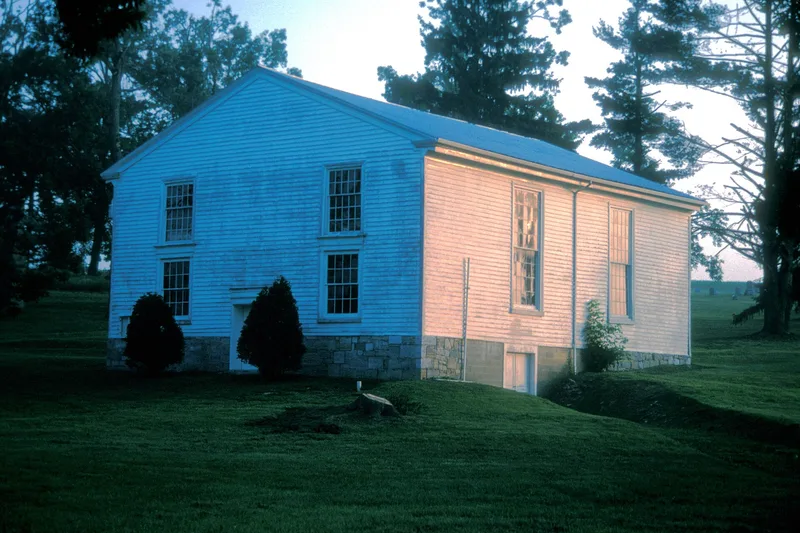
St. John's Lutheran Church and Cemetery sits on an open hillside along U.S. Route 21 north of Wytheville. The congregation was organized in 1800 as a joint effort of Lutheran and German Reformed worshippers, and the present white frame church, measuring 55 by 45 feet, was built in 1854 on a high limestone basement. Its exposed roof structure follows German framing traditions found in Pennsylvania, Maryland and Virginia. Inside are simple slip pews, a gallery on Greek Doric piers and a rail once used to separate men from women. The cemetery holds about thirty early nineteenth-century German-style monuments, most carved by Laurence Krone, the only early western Virginia carver known by name. His 1826 tomb for pastor George Flohr is among his best works. Together the church and gravestones form one of Virginia's most complete groups of German immigrant religious art. Regular services ended in 1924, and the church is now used once a year.
Machine-generated summary. This summary was generated by a language model from the official nomination document and has not been reviewed line by line by an editor. It may contain errors. Check the source document before relying on any detail. Source: nomination document (PDF) · catalog entry. Generated October 2026 (model claude-sonnet-5-5, prompt v1.0-2026-10-29).
| Period of significance | 1800-1899 |
|---|---|
| Areas of significance | Art, European, Exploration/Settlement, Architecture, Religion |
| Acreage | 6 |
| Boundary source | not published |
| Full listing page | St. John's Lutheran Church and Cemetery (property record) |
What listing means for this property
This is a historic district. Buildings within its boundary are either contributing (they add to the district's significance) or non-contributing. Owners of contributing income-producing buildings can claim the 20% federal rehabilitation tax credit; homeowners should look at state credits. National Register districts impose no design review by themselves; a local historic district ordinance, if one exists, does (the difference explained).
General information, not legal or tax advice. Rules change; confirm with your State Historic Preservation Office or a qualified adviser.