Snowville Historic District

Why it's listed
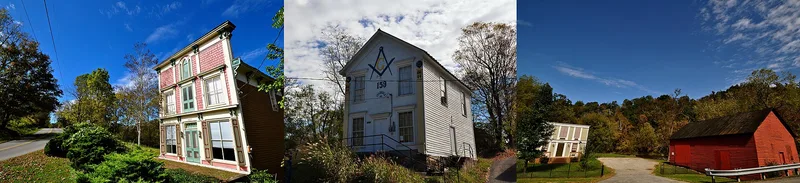
Snowville is a small village strung along State Route 693 in a bend of the Little River in Pulaski County, Virginia. Cabinetmaker Asiel Snow settled there in 1833, drawn by the river's water power, and the village became the county's manufacturing center by the 1850s, with a linseed-oil factory, sawmill and wool-carding operation. The railroad bypassed it in the mid 1850s and it declined. The district includes 21 contributing buildings, among them a church, a Masonic temple, a school, a former blacksmith shop and many wood-frame houses, plus a cemetery. Most are vernacular, and several show Greek Revival detailing. Dr. Chester Bullard helped establish the Christian Church in southwestern Virginia. The village also had the county's first Masonic temple, newspaper and public library. Similar scale and materials, open surrounding land and few modern intrusions keep the nineteenth-century rural character of a pre-railroad industrial village.
Machine-generated summary. This summary was generated by a language model from the official nomination document and has not been reviewed line by line by an editor. It may contain errors. Check the source document before relying on any detail. Source: nomination document (PDF) · catalog entry. Generated October 2026 (model claude-sonnet-5-5, prompt v1.0-2026-10-29).
| Period of significance | mid 19th-early 20th centuries |
|---|---|
| Styles | Vernacular, with Greek Revival detailing on several buildings |
| Areas of significance | Industry, Architecture, Religion, Social History |
| Acreage | 76 |
| Boundary source | NPS cultural-resource GIS polygon |
| Full listing page | Snowville Historic District (property record) |
What listing means for this property
This is a historic district. Buildings within its boundary are either contributing (they add to the district's significance) or non-contributing. Owners of contributing income-producing buildings can claim the 20% federal rehabilitation tax credit; homeowners should look at state credits. National Register districts impose no design review by themselves; a local historic district ordinance, if one exists, does (the difference explained).
General information, not legal or tax advice. Rules change; confirm with your State Historic Preservation Office or a qualified adviser.